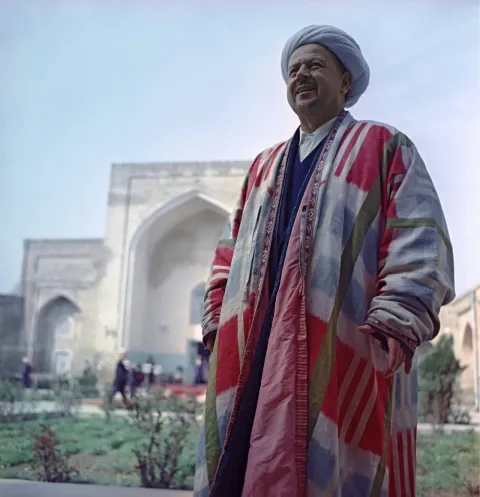
Ziyauddinkhan Babakhanov
Shaykh who chaired the Spiritual Administration of the Muslims of Central Asia and Kazakhstan from 1957 to 1982 as mufti of five republics and helped found the Tashkent Islamic Institute.
- Occupation:
- Religious figure, Scientist
- Born:
- January 8 1908(74 years old) ♑ — December 23, 1982
- Birthplace:
- Tashkent
- Father:
- Eshon Boboxon ibn Abdumajidxon
- Children:


Biography
Ziyauddinkhan ibn Ishan Babakhan was born in January 1908 in Tashkent. His father, Ishan Babakhan ibn Abdulmajidkhan, was imam of the Tilla Shaykh mosque and later the first head of the Spiritual Administration of the Muslims of Central Asia and Kazakhstan. The boy grew up listening to his father’s lessons, learned Qur’an recitation from Hakimqori, imam-khatib of the Tilla Shaykh mosque, and knew the whole Qur’an by heart at twelve.
In 1920 he entered the Kukeldash madrasa. He studied hadith and tafsir under several teachers, among them the Syrian scholar Muhammad ibn Said al-Asali ash-Shami at-Tarabulusi, who had moved to Tashkent in the 1920s and whom he later regarded as his principal teacher. After the madrasa he served as imam-khatib in Tashkent mosques. In the years of militant atheism the Babakhan family was persecuted: its property was confiscated in 1928, and in 1941 he was arrested together with his father, although the case was closed that October.
When the state’s attitude to religion softened during the war, the first congress of Muslims in Tashkent in October 1943 set up the Spiritual Administration of the Muslims of Central Asia and Kazakhstan (SADUM). He was elected its executive secretary and the qadi of Uzbekistan, and took charge of reopening mosques, drafting fatwas and helping the families of soldiers at the front. In 1947–1948 he studied with sheikhs of al-Azhar in Cairo and visited Mecca and Medina; after his return he was elected deputy chairman in 1948.
After his father’s death he was elected chairman of the Administration and mufti of five republics at the third congress in June 1957, and held the post until 1982. An edition of the Qur’an prepared under his direction appeared in 1957, with further editions in 1960 and 1968. At his initiative al-Bukhari’s “Al-Jami al-Sahih” and “Al-Adab al-Mufrad” were published in Arabic. In 1962 the Department of International Relations of Muslim Organisations of the USSR was formed, and he was chosen to head it.
He became a well-known figure in the Muslim world: he helped organise conferences in Samarkand (1974, for the 1,200th anniversary of al-Bukhari), Tashkent (1976 and 1980) and Moscow, and belonged to the Supreme Council of Mosques (Mecca, 1976) and the World Peace Council. In 1971 the Imam al-Bukhari Islamic Institute opened in Tashkent, the first higher Islamic school in the USSR, a result largely of his efforts. He translated Ibn Sina’s book on hygiene into Uzbek and Russian, published a book in Russian on Islam and Muslims in the country in 1979, and wrote poetry under the pen name Futuhiy.
He retired in October 1982 because of poor health and died in Tashkent on 23 December of that year. With the permission of the government he was buried beside his father near the mausoleum of Kaffal Shashi. His son Shamsiddinkhan Babakhanov succeeded him at the head of the Administration. A mosque and a street in Tashkent bear his name; an international conference marked the 90th anniversary of his birth in 1998, and in 2023 he was posthumously awarded the Order “Oliy darajali Imom Buxoriy”.
Education
- Kukeldash Madrasa (Tashkent)Madrasa · Tashkent · 1920
- Al-Azhar UniversityUniversity · 1947–1948
Career
- Imam al-Bukhari Tashkent Islamic InstituteCo-founder and head · Tashkent · 1971–…Everyone who held this post →
- Spiritual Administration of the Muslims of Central Asia and KazakhstanExecutive secretary (1943), deputy chairman (1948), chairman and mufti of five republics (1957–1982) · Tashkent · 1943–1982
- Department of International Relations of Muslim Organisations of the USSRHead of the department · 1962–1982Everyone who held this post →
Awards
Life path
- 1908Birth
Born in Tashkent into the family of the religious leader Ishan Babakhan.
- 1920Kukeldash madrasa
After memorising the Qur’an he entered the Kukeldash madrasa to study hadith and tafsir.
- 1941Arrest
Arrested with his father for religious teaching; the case was closed in October of the same year.
- 1943Executive secretary of SADUM
Elected executive secretary and qadi of Uzbekistan at the first congress, which created the Administration.
- 1947–1948Al-Azhar, Mecca and Medina
Studied with sheikhs of al-Azhar in Cairo and visited Mecca and Medina.
- 1948Deputy chairman
Elected deputy chairman of the Administration at the second congress.
- 1957Mufti of five republics
Elected chairman and mufti at the third congress; an edition of the Qur’an appeared the same year.
- 1962Department of International Relations
Chosen to head the Department of International Relations of Muslim Organisations of the USSR.
- 1971Islamic Institute in Tashkent
The Imam al-Bukhari Islamic Institute opened in Tashkent.
- 1974Samarkand conference
Helped organise the international conference marking the 1,200th anniversary of al-Bukhari.
- 1982Retirement and death
Retired in October and died on 23 December.