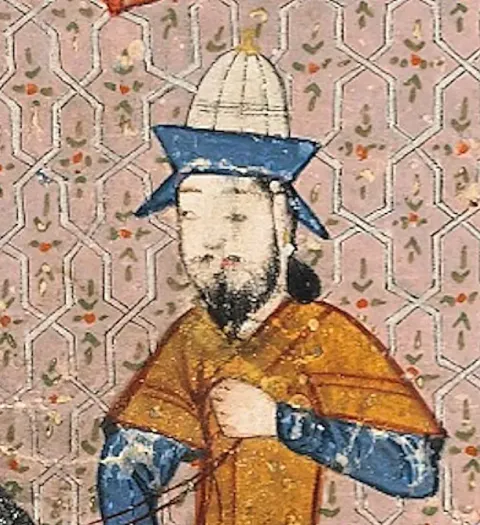
Shah Rukh
Youngest son of Amir Timur and supreme ruler of the Timurid state (1409–1447) who made Herat his capital, entrusted Transoxiana to his son Ulugh Beg and was known as a patron of learning and the arts.
- Occupation:
- Historical figure, Politician, Military officer
- Born:
- August 20 1377(69 years old) ♌ — March 12, 1447
- Birthplace:
- Samarkand
- Father:
- Amir Timur
- Spouse:
- Gawhar Shad
- Children:
- Ibrohim SultonBoysunqur MirzoSuyurg'atmish MirzoMuhammad Jo'ki Mirzo
Biography
Shah Rukh was born in Samarkand on 20 August 1377, the fourth and youngest son of Amir Timur. The sources disagree about his mother: the Timurid historian Khwandamir names her as Taghay Tarkhan Agha, of Qara Khitai origin, while other sources name Saray Mulk Khanum. According to many accounts the boy was brought up by Timur’s senior wife, Saray Mulk Khanum. Around 1388 Shah Rukh married Gawhar Shad, daughter of Emir Ghiyath al-Din Tarkhan. His sons Ulugh Beg and Ibrahim Sultan were born in 1394 and Baysunghur in 1397.
From an early age he took part in his father’s campaigns. In 1393 the Muzaffarid ruler Shah Mansur was killed in battle near Shiraz; according to the sources, it was the sixteen-year-old Shah Rukh who brought his head to Timur. In 1397 Timur made him governor of Khorasan, Sistan and Mazandaran; Shah Rukh settled in Herat and remained governor of Khorasan until 1405. In 1402 he also fought at the Battle of Ankara against the army of the Ottoman sultan Bayezid I.
Timur’s death in February 1405 set off a struggle for the throne. His grandson Khalil Sultan seized Samarkand, while Shah Rukh held on to Khorasan and allied himself with Timur’s designated heir Pir Muhammad, who was murdered in 1407. When Khalil Sultan lost the support of his emirs in 1409, Shah Rukh entered Samarkand without a fight. He entrusted Transoxiana to his son Ulugh Beg, returned to Herat and made it the capital of the whole state. In the following years he brought to heel the nephews who refused to recognise him: in 1414 he put down Iskandar Sultan’s revolt in Fars and Isfahan, and in 1416 he took Kerman. By 1420 Timur’s eastern lands and central and southern Iran were under his rule.
In the west Shah Rukh campaigned three times, in 1420–21, 1429 and 1434–35, against the Qara Qoyunlu Turkmens who held Azerbaijan; Tabriz was occupied for a time, and in the end the Qara Qoyunlu ruler Jahan Shah acknowledged his overlordship. Unlike his father, Shah Rukh kept no Chinggisid figurehead khans, used the titles sultan and padishah and placed the sharia above the Chinggisid yasa. In 1427 Ahmad Lur, a man linked to the Hurufis, stabbed him in the Friday mosque of Herat; Shah Rukh recovered, and the attempt was followed by a persecution of the Hurufis.
Shah Rukh regularly exchanged embassies with Ming China: Ghiyath al-Din Naqqash, a member of the large embassy to Beijing in 1419–22, left a diary of the journey. He also kept up diplomatic ties with the sultans of Delhi, Bengal, Mamluk Egypt and the Ottoman Empire, and in 1442 he sent the historian Abd al-Razzaq Samarqandi as envoy to southern India, to Calicut and Vijayanagara.
Under him Herat became the political and cultural centre of the Timurid state: the citadel and the bazaar were rebuilt and enlarged, and crafts and trade flourished. Gawhar Shad built a congregational mosque at the shrine of Imam Reza in Mashhad and a mosque and madrasa complex in Herat, and she wielded great influence in affairs of state. Shah Rukh’s son Baysunghur founded a kitabkhana in Herat where calligraphers and painters worked, and Ulugh Beg built a madrasa and an observatory in Samarkand. The court historian Hafiz-i Abru wrote historical and geographical works at Shah Rukh’s behest, and Sharaf al-Din Ali Yazdi wrote his “Zafarnama” for Ibrahim Sultan. The Encyclopaedia Iranica describes Shah Rukh as a ruler who won a great reputation as a friend of scholars and poets and a patron of architecture.
In 1446 his grandson Sultan Muhammad, son of Baysunghur, rebelled in western Iran, seized Hamadan and Isfahan and besieged Shiraz. Shah Rukh, then nearly seventy, marched against him, and the rebels fled. On the way back he fell ill and died near Ray on 12 March 1447, and a struggle for power broke out among his grandsons. His body was first laid in Gawhar Shad’s mausoleum in Herat; in 1448 Ulugh Beg brought his father’s remains to Samarkand and buried them in the Gur-e Amir. In 1941 an expedition led by the anthropologist Mikhail Gerasimov opened and studied the Timurid tombs in the Gur-e Amir, Shah Rukh’s among them.
Career
- Timurid EmpireSupreme ruler (in Khorasan from 1405, of the whole state from 1409) · 1405–1447Everyone who held this post →
Life path
- 1377Birth
Born in Samarkand on 20 August to Amir Timur.
- 1393Battle near Shiraz
Fought in the battle in which the Muzaffarid Shah Mansur was killed.
- 1397Governor of Khorasan
Appointed by Timur governor of Khorasan, Sistan and Mazandaran, with his seat in Herat.
- 1402Battle of Ankara
Fought against the army of the Ottoman sultan Bayezid I.
- 1405–1409Struggle for the throne
After Timur’s death held on to Khorasan and contended with Khalil Sultan.
- 1409Supreme ruler
Took Samarkand, entrusted Transoxiana to Ulugh Beg and made Herat his capital.
- 1414–1416Securing Iran
Put down Iskandar Sultan’s revolt in Fars and Isfahan and took Kerman.
- 1419–1422Embassy to China
Sent a large embassy to Beijing, described by Ghiyath al-Din Naqqash.
- 1420–1435Campaigns against the Qara Qoyunlu
Campaigned three times in Azerbaijan; in the end Jahan Shah acknowledged his overlordship.
- 1427Assassination attempt
Stabbed in the Friday mosque of Herat, but recovered.
- 1447Death
Died near Ray on 12 March, on his way back from the campaign against his grandson Sultan Muhammad.
Legacy
For nearly forty years Shah Rukh held together a state that was in danger of breaking apart after Timur’s death. His reign is regarded as the high point of the Timurid Renaissance, when learning, literature, architecture and the arts of the book flourished in Herat and Samarkand: the buildings of Gawhar Shad, Baysunghur’s kitabkhana, Ulugh Beg’s observatory and the histories of Hafiz-i Abru and Sharaf al-Din Ali Yazdi all belong to these years. The records of his embassies to China, India and the West are an important source on the international relations of the age.
Era: The Timurid era, first half of the 15th century- The Gawhar Shad Mosque was built at the shrine of Imam Reza in Mashhad (1418)
- Shah Rukh’s envoys set out for Beijing; Ghiyath al-Din Naqqash kept a diary of the embassy (1419)
- Abd al-Razzaq Samarqandi set out as Shah Rukh’s envoy to southern India (1442)
- Ulugh Beg brought his father’s remains from Herat to Samarkand and buried them in the Gur-e Amir (1448)
- Mikhail Gerasimov’s expedition opened the Timurid tombs in the Gur-e Amir, including Shah Rukh’s (1941)
- Samarkand, with the Gur-e Amir, was inscribed on the UNESCO World Heritage List as “Samarkand – Crossroad of Cultures” (2001)