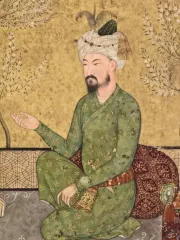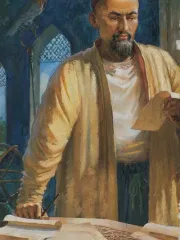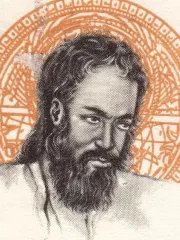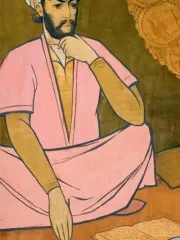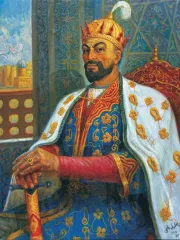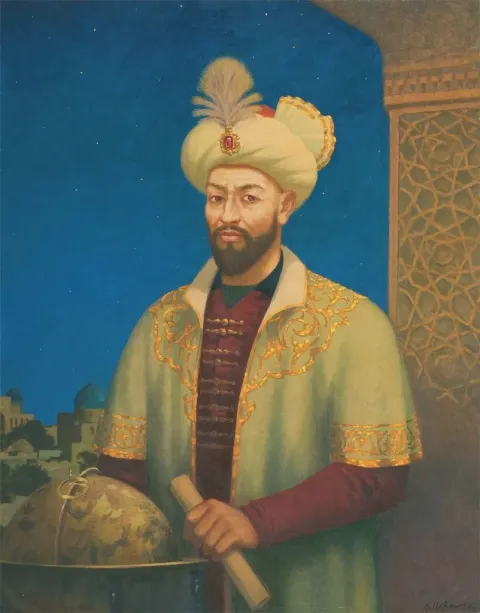
Mirzo Ulugbek
Astronomer and ruler, founder of the Samarkand observatory.
- Occupation:
- Scientist, Mathematician, Astronomer
- Lived:
- March 22 1394(55 years old) ♈ — October 27, 1449
- Father:
- Shohruh Mirzo
- Mother:
- Gavharshod begim
- Children:
Biography
Mirzo Ulugbek (Muhammad Taraghay) was born on 22 March 1394 in Soltaniyeh, in present-day Iran, during a military campaign of his grandfather, Amir Timur. His father was Shah Rukh, Timur’s son and the ruler of Khorasan; his mother was Gawhar Shad Begum, an influential queen and patron of architecture.
From 1409, while still a teenager, Ulugbek governed Samarkand and Transoxiana on behalf of his father, who kept supreme power over the whole Timurid state from Herat. On his orders madrasas were built in Samarkand and Bukhara in 1417–1420 and in Gijduvan in 1433, where mathematics and astronomy were taught alongside theology.
Between 1424 and 1428 Ulugbek built one of the largest observatories of the medieval world on Kuhak Hill near Samarkand. Its main instrument, a sextant with a radius of about forty metres cut into the hillside, made it possible to measure the positions of the heavenly bodies with an accuracy unheard of in its time.
The observatory’s work culminated in 1437 in the star catalogue “Zij-i Gurgani”, with the coordinates of 1,018 stars and trigonometric tables of sines and tangents accurate to the eighth decimal place. For centuries the catalogue remained the most accurate in both the East and Europe.
After Shah Rukh’s death in 1447 Ulugbek became head of the whole Timurid empire but could not hold on to power: two years later, in 1449, he was overthrown and executed on the orders of his own son, Abd al-Latif. Soon afterwards the observatory was destroyed.
In Samarkand Ulugbek gathered more than a hundred scholars around him. The most eminent were Qadi Zada al-Rumi and Ghiyath al-Din Jamshid al-Kashi, and Ali Qushji, one of his best-known pupils, joined the circle later. Ulugbek himself also gave lectures in the madrasas.
During his rule Ulugbek led two long campaigns. In 1425 he marched against Shir Muhammad, ruler of Moghulistan, and won, though the victory had little lasting effect. In 1427 he was defeated by Baraq near Sighnaq, and that was his last campaign against a neighbouring power.
Career
- Ulugh Beg Observatory in SamarkandFounder · 1424–1449
Life path
- 1409Ruler of Samarkand
While still a teenager he began to govern Samarkand and Transoxiana on behalf of his father, Shah Rukh.
- 1417–1433Building madrasas
On his orders madrasas were built in Samarkand, Bukhara and Gijduvan, where the exact sciences were taught alongside theology.
- 1424–1428Building the observatory
One of the largest observatories of the medieval world was built on Kuhak Hill near Samarkand.
- 1437Completion of the “Zij-i Gurgani”
A star catalogue with the coordinates of 1,018 stars and trigonometric tables was compiled.
- 1447Head of the Timurid empire
After the death of his father, Shah Rukh, he became head of the whole Timurid state.
- 1449Overthrow and death
Overthrown and executed on the orders of his own son, Abd al-Latif; soon afterwards the observatory was destroyed.
Works
- “Zij-i Gurgani” (1437)Science
Star catalogue with the coordinates of 1,018 stars and trigonometric tables of sines and tangents accurate to eight decimal places.
- “Tarikh-i Arba Ulus”History
A history of the four uluses — the Mongol and Turkic dynasties descended from Genghis Khan.
Legacy
For centuries the accuracy of Ulugbek’s star catalogue and trigonometric tables had no equal in either the East or Europe; European astronomers used them up to the time of Tycho Brahe. A crater on the Moon and an asteroid are named after him, and in independent Uzbekistan so is the country’s largest university.
Era: Timurid Samarkand- The German astronomer Johann Mädler named a lunar crater after him (1830)
- The archaeologist Vasily Vyatkin excavated the ruins of the observatory near Samarkand (1908)
- The asteroid 2439 Ulugbek was discovered; Mirzo Ulugbek metro station opened in Tashkent (1977)
- Tashkent State University was named after Mirzo Ulugbek (1995)