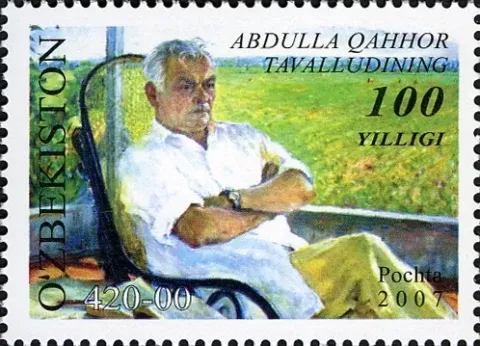
Abdulla Qahhor
Uzbek writer, playwright and translator, People’s Writer of the Uzbek SSR and a master of the short story, author of the novel “Mirage”, the novellas “Sinchalak” and “Tales from the Past” and the story “The Thief”.
- Occupation:
- Writer, Prose writer, Playwright
- Born:
- September 17 1907(60 years old) ♍ — May 25, 1968
- Birthplace:
- Kokand, Fergana
- Father:
- Abduqahhor Jalilov
- Mother:
- Rohat
- Spouse:
- Kibriyo Qahhorova
Biography
Abdulla Qahhor was born in Kokand on 17 September 1907 to the blacksmith Abduqahhor Jalilov and his wife Rohat (some sources give his birthplace as Asht in present-day Tajikistan). His father’s trade could not keep the family, so he moved from village to village around Kokand in search of work, and the boy grew up in Yaypan, Buvayda, Oqqo'rg'on and other villages. He studied at a new-method school in Oqqo'rg'on, at town schools after the family settled in Kokand, and then at the Kokand teacher-training college.
His first poem, “When the Moon Was Eclipsed”, appeared in the satirical magazine “Mushtum” in 1924 under the pen name Norin shilpiq; he signed later satirical verse and stories as Gulyor, Nish, Erkaboy and other names. After college he worked for the Kokand town Komsomol committee, and in 1925 he moved to Tashkent, where he ran the readers’ letters page of the newspaper “Qizil O'zbekiston” and attended the workers’ faculty of the Central Asian State University. In 1929 he taught at a teachers’ course in Kokand and worked for the newspaper “Yangi Farg'ona”, and in 1930–1934 he studied at the university’s Faculty of Pedagogy.
After the story “The Headless Man” (1929) Qahhor concentrated on prose, publishing the novella “The Village on Trial” (1932), his first collection of stories, “The World Grows Young”, and the novel “Mirage” (1935), about the fate of the Uzbek intellectual Saidiy in the late 1920s. In the mid-1930s he wrote the stories “The Thief”, “The Patient”, “The Pomegranate”, “The Nationalists” and “The Literature Teacher”. He later said that reading Chekhov helped him see his childhood experiences with new eyes, and he is often called “the Uzbek Chekhov”. In 1934–1938 he was executive secretary of the magazine “Sovet adabiyoti” (today “Sharq yulduzi”), in 1938–1939 head of the literary department of the Hamza Theatre, and then for many years an editor and translator at the State Publishing House of Uzbekistan.
During the war he wrote about soldiers and home-front workers in the stories “Grandpa Asror”, “A Hero from Dardaq” and “The Old Women Sent a Telegram” and the novella “The Golden Star”. After the war came the novel “The Lights of Qo'shchinor” (1951), set in the years of collectivisation. His comedy “Shohi so'zana” (“Silk Suzani”, also called “The New Land”, 1950), about the reclamation of the Mirzacho'l steppe, won a Stalin Prize in 1952 and was widely staged. It was followed by the comedies “Aching Teeth” (1954), “A Voice from the Coffin” (1962) and “My Dear Mothers” (1967). Qahhor joined the Communist Party in 1952, chaired the board of the Writers’ Union of Uzbekistan in 1954–1956 and was elected to the Supreme Soviet of the Uzbek SSR in 1955.
His best-known novellas date from his last decade: “Sinchalak” (1958; filmed by Latif Fayziyev in 1961), about Saida, a young party secretary who stands up to the high-handed collective-farm chairman Qalandarov, the autobiographical “Tales from the Past” (1965) and “Love” (1968). “Tales from the Past” won him the Hamza State Prize of the Uzbek SSR in 1966 and was translated into Russian by Konstantin Simonov and Kamron Hakimov. In 1959 he began “Earthquake”, a novella about the Stalinist repressions, but never finished it; the surviving chapters were published in “Sharq yulduzi” in 1987.
Qahhor translated into Uzbek Pushkin’s “The Captain’s Daughter”, Gogol’s “The Government Inspector” and “Marriage”, Gorky’s “My Universities”, Serafimovich’s “The Iron Flood” and stories by Chekhov, and, together with his wife, the translator Kibriyo Qahhorova, Tolstoy’s “War and Peace”. His own works have been translated into Russian and many other languages.
In 1967, on his 60th birthday, Abdulla Qahhor was named People’s Writer of the Uzbek SSR. Long ill, he went to Moscow for treatment and died there on 25 May 1968; he was buried in the Chig'atoy cemetery in Tashkent. In 2000 he was posthumously awarded the Order “For Outstanding Merit” (“Buyuk xizmatlari uchun”). The Tashkent house where he lived from 1958 to 1968 became a museum on 6 May 1987, on the initiative of Kibriyo Qahhorova. Streets in Tashkent and Kokand bear his name; his centenary in 2007 was widely celebrated and marked with postage stamps.
Education
- National University of UzbekistanUniversity · Tashkent · 1926–1934 · Workers’ faculty, then Faculty of Pedagogy (Central Asian State University)
- Kokand Pedagogical CollegeCollege · Kokand
Career
- Qizil O'zbekiston newspaperEditor of the readers’ letters page · Tashkent · 1925–…
- «Sharq yulduzi» magazineExecutive secretary (when the magazine was called “Sovet adabiyoti”) · Tashkent · 1934–1938
- Writers' Union of UzbekistanChairman of the board · Tashkent · 1954–1956Everyone who held this post →
- State Publishing House of UzbekistanEditor and translator · Tashkent · 1939–…
- Supreme Soviet of the Uzbek SSRDeputy · Tashkent · 1955–1959
- Uzbek National Academic Drama TheatreHead of the literary department · Tashkent · 1938–1939
Awards
 Order «For Outstanding Merit»2000, posthumously · Uzbekistan
- People's Writer of the Uzbek SSR1967 · Uzbek SSR
 Hamza State Prize of the Uzbek SSR1966 · Uzbek SSR
 Order of the Red Banner of Labour1951 · USSR
- Order of the Red Banner of Labour1957 · USSR
- Order of the Red Banner of Labour1967 · USSR
 Order of the Badge of Honour1939 · USSR
 Stalin Prize1952 · USSR
Life path
- 1924First poem
The poem “When the Moon Was Eclipsed” appeared in “Mushtum” under the pen name Norin shilpiq.
- 1925–1928In Tashkent
Worked for the newspaper “Qizil O'zbekiston” and attended the workers’ faculty of the Central Asian State University.
- 1929Turn to prose
Published the story “The Headless Man”; taught at a teachers’ course in Kokand and worked for the newspaper “Yangi Farg'ona”.
- 1930–1934University
Studied at the Faculty of Pedagogy of the Central Asian State University.
- 1934–1939Magazine and theatre
Executive secretary of the magazine “Sovet adabiyoti”; in 1938–1939 head of the literary department of the Hamza Theatre.
- 1935“Mirage”
His first novel was published.
- 1951–1952“The Lights of Qo'shchinor” and the Stalin Prize
The novel came out; the comedy “Silk Suzani” won a Stalin Prize.
- 1954–1956Head of the Writers’ Union
Chaired the board of the Writers’ Union of Uzbekistan; elected to the Supreme Soviet of the Uzbek SSR in 1955.
- 1958“Sinchalak”
The novella was published; it was filmed in 1961.
- 1965–1966“Tales from the Past”
The autobiographical novella came out and won the Hamza State Prize.
- 1967People’s Writer of the Uzbek SSR
Received the honorary title on his 60th birthday.
- 1968Death
Died in Moscow on 25 May and was buried in the Chig'atoy cemetery in Tashkent.
Works
- “Mirage” (“Sarob”) (1935)Novel
His first novel, about the fate of the Uzbek intellectual Saidiy in the late 1920s.
- “The Thief” (“O'g'ri”) (1936)Short story
About Qobil bobo, a poor peasant whose ox is stolen; one of the writer’s best-known stories.
- “The Patient” (“Bemor”) (1936)Short story
About Sotiboldi, a poor man who cannot find a cure for his gravely ill wife.
- “Silk Suzani” (“Shohi so'zana”) (1950)Comedy
Also known as “The New Land”; about the reclamation of the Mirzacho'l steppe. Stalin Prize, 1952.
- “The Lights of Qo'shchinor” (1951)Novel
Set in the years of collectivisation; its first version was called “Qo'shchinor”.
- “Sinchalak” (1958)Novella
About Saida, a young party secretary who stands up to a high-handed collective-farm chairman; filmed in 1961.
- “A Voice from the Coffin” (1962)Comedy
A satirical play about the vices of its time.
- “Tales from the Past” (“O'tmishdan ertaklar”) (1965)Autobiographical novella
Based on childhood memories; Hamza State Prize, 1966; translated into Russian by Konstantin Simonov and Kamron Hakimov.
- “Love” (1968)Novella
A novella about young people, the last one the writer completed.
- “Earthquake” (“Zilzila”)Unfinished novella
About the Stalinist repressions; begun in 1959, its surviving chapters were published in 1987.
- Translation of Tolstoy’s “War and Peace”Translation
Translated the novel into Uzbek together with his wife, Kibriyo Qahhorova.
Legacy
Abdulla Qahhor is regarded as a master of the Uzbek short story; for his terse, unadorned prose and his humour he is called “the Uzbek Chekhov”. He influenced later writers such as O'tkir Hoshimov, Erkin Vohidov and Abdulla Oripov, and Said Ahmad considered himself his pupil to the end of his life. His translations of the Russian classics, “War and Peace” among them, are landmarks of Uzbek literary translation. His house in Tashkent is a museum, and streets in Tashkent and Kokand bear his name.
Era: Uzbek Soviet literature of the mid-20th century- The comedy “Silk Suzani” won a Stalin Prize (1952)
- The novella “Sinchalak” was filmed (1961)
- Named People’s Writer of the Uzbek SSR (1967)
- The Abdulla Qahhor House Museum opened in Tashkent and chapters of “Earthquake” were published (1987)
- Posthumously awarded the Order “For Outstanding Merit” (2000)
- His centenary was marked and postage stamps were issued (2007)