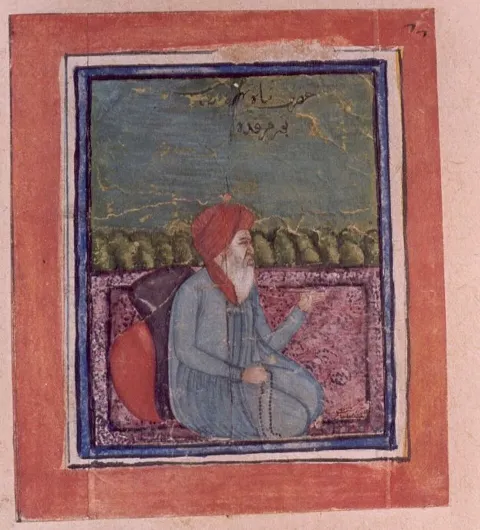
Baha al-Din Naqshband
Fourteenth-century Sufi master from near Bukhara, founder of the Naqshbandi order, one of the largest Sufi orders in the world, revered as the spiritual patron of Bukhara.
- Occupation:
- Religious figure
- Real name:
- Muhammad ibn Muhammad al-Bukhari
- Nickname:
- Khwaja Baha al-Din, Shah-i Naqshband
- Born:
- 1318 — March 2, 1389
- Birthplace:
- Kogon District, Bukhara
Biography
Baha al-Din Naqshband — in full Khwaja Muhammad ibn Muhammad al-Bukhari — was born in 718 AH (1318) in the village of Qasr-i Hinduvan near Bukhara. The village was later renamed Qasr-i Arifan, “the castle of the gnostics”, in his honour; today it lies in the Kogon District of Bukhara Region. Later traditions tracing his family to the Prophet’s descendants are treated with caution by scholars. The early sources do not explain the name Naqshband: tradition links it to his father’s craft as a maker of patterns, while Sufis took it to mean the “imprint” (naqsh) that constant dhikr leaves on the heart.
According to Naqshbandi sources, his grandfather’s spiritual master, Baba Muhammad Sammasi, a shaykh of the Khwajagan line, used to say when passing Qasr-i Hinduvan that a great man would come from its soil, and when the baby was three days old he adopted him as his spiritual son and entrusted his upbringing to his disciple Sayyid Amir Kulal. Baha al-Din spent many years in Amir Kulal’s circle, learning the ways of the Sufi path. During that time, after a dream and a series of spiritual experiences, he came to regard himself as a disciple of Abd al-Khaliq Ghijduvani, who had died a century earlier, in 1220 — which is why he is counted among the Uwaysis, those initiated by a master no longer living. According to tradition, Ghijduvani told him to keep strictly to the Sharia, to avoid seeking dispensations and to follow the example of the Prophet.
After this Baha al-Din moved from vocal dhikr to silent dhikr, remembrance of God performed in the heart. Amir Kulal’s circle practised dhikr aloud, and the change caused resentment among the disciples, but Amir Kulal defended him; one day he called Baha al-Din away from carrying bricks for a mosque being built in the village of Sukhar and told him his training was complete and that he was now free to learn from any master, Turk or Tajik. Baha al-Din then attended the gatherings of another of Amir Kulal’s disciples, Mawlana Arif Dikgarani, and later joined two Turkic shaykhs of the Yasawiyya order: he stayed only a short time with Qusam Shaykh, but twelve years with Khalil Ata. Some historians identify Khalil Ata with Qazan Khan, who ruled the Chagatai Khanate until 1347; according to the sources, Baha al-Din stayed with him until the khan was overthrown in a rebellion.
He then returned to his native village and began training disciples. He spent almost his whole life around Bukhara and left the region only three times: twice to perform the hajj, staying three days in Herat on the second journey, and once to visit Herat at the invitation of its Kartid ruler, Mu’izz al-Din Husayn, to whom he explained the principles of his path. His successors included his son-in-law Khwaja Ala al-Din Attar, the leading Bukhara scholar Khwaja Muhammad Parsa and Mawlana Ya’qub Charkhi. Baha al-Din died on 3 Rabi al-Awwal 791 AH (2 March 1389) in his native village and was buried there.
At the heart of the Naqshbandi path is constant silent dhikr of the heart. Baha al-Din did not accept sama — ritual listening with music and dance — or long retreats as means of spiritual growth, gave his disciples no special dress and did not like sitting in the Sufi lodge; he set little value on miracles or on belonging to a chain of masters for its own sake. For this reason scholars also see him as an heir of the Malamatiyya, a movement that arose in Nishapur. To the eight rules inherited from Ghijduvani — “awareness in breathing”, “watching one’s step”, “journeying within”, “solitude in the crowd” and others — he is held to have added three more: awareness of time, awareness of number and awareness of the heart. The saying linked to his name, “Dil ba yor-u dast ba kor” (“The heart with the Beloved, the hands at work”), is well known among the Naqshbandis.
Baha al-Din wrote no books, and no work setting out his views has come down to us. His sayings and life are known from the writings of his disciples and later authors: above all Khwaja Muhammad Parsa’s “Risala-yi qudsiyya”, and also Salah ibn Mubarak Bukhari’s “Anis al-talibin”, Abd al-Rahman Jami’s “Nafahat al-uns” and Fakhr al-Din Ali Safi’s “Rashahat ayn al-hayat”. The prayer collection “Awrad-i Baha’iyya” may be his, while treatises attributed to him such as the “Hayat-nama” and “Dalil al-ashiqin” were most likely written by others.
After his death Baha al-Din came to be revered as the spiritual patron of Bukhara: its people called him “Khwaja-yi balogardon”, the averter of misfortune, and the phrase “Bahouddin balogardon” is still in use. The order took his name as well: the chain of masters formerly known as “the way of the Khwajagan” was henceforth called the Naqshbandiyya. Over the centuries a large complex grew up around his grave: in 1544–1545 Abd al-Aziz Khan of Bukhara built a khanqah there, mosques and pools were added later, and a minaret in 1885. Following a government decree of 28 October 1992, Uzbekistan marked the 675th anniversary of his birth in 1993 with a commemorative gathering and a scientific conference in Bukhara, and the complex was restored.
Career
- Yasawiyya Sufi orderDisciple of Qusam Shaykh and Khalil Ata · …–1347
- Naqshbandi Sufi orderFounder (pir) · …–1389
- Khwajagan Sufi orderDisciple of Amir Kulal
Life path
- 1318Born in Qasr-i Hinduvan
At three days old he was adopted as a spiritual son by the Khwajagan shaykh Baba Muhammad Sammasi.
- Disciple of Amir Kulal
Spent many years learning the Sufi path in the circle of Sammasi’s disciple, Sayyid Amir Kulal.
- The way of Ghijduvani
Instructed in a dream by the spirit of Abd al-Khaliq Ghijduvani, he moved from vocal to silent dhikr; Amir Kulal declared his training complete.
- Arif Dikgarani and Qusam Shaykh
Attended the gatherings of Mawlana Arif Dikgarani, then stayed briefly with the Yasawi master Qusam Shaykh.
- until 1347With Khalil Ata
Spent twelve years with the Yasawi master Khalil Ata, whom some historians identify with the Chagatai khan Qazan.
- Return to Qasr-i Hinduvan
Went back to his native village and began training disciples; his successors included Ala al-Din Attar, Muhammad Parsa and Ya’qub Charkhi.
- Hajj and visits to Herat
Performed the hajj twice and visited Herat at the invitation of the Kartid ruler Mu’izz al-Din Husayn, explaining to him the principles of his path.
- 1389Death
Died on 2 March in his native village and was buried there; the village was later renamed Qasr-i Arifan.
Legacy
Baha al-Din became the central link of the Khwajagan line, and from him onwards the path was called the Naqshbandiyya; the weight he gave to silent dhikr defined the order’s character. Three generations after his death the Naqshbandiyya began to spread widely among the Turkic peoples of Central Asia; under Khwaja Ubaydullah Ahrar (d. 1490) it became the most influential order in Transoxiana and spread across the Islamic world, and Abd al-Rahman Jami and Alisher Navoi belonged to it. It later took root in India, the Ottoman Empire, the Caucasus and the Volga region, and Imam Rabbani (d. 1624) and Khalid al-Baghdadi (d. 1827) founded new branches of it. In Bukhara Baha al-Din is revered as the city’s spiritual patron and one of its “seven saints”, and his complex at Qasr-i Arifan has been one of the best-known places of pilgrimage in Central Asia for centuries.
Era: 14th century, the Chagatai Khanate and the age of Amir Timur- Baha al-Din Naqshband died and was buried in Qasr-i Hinduvan (1389)
- Abd al-Aziz Khan of Bukhara built a khanqah beside his grave (1544)
- A minaret was added to the complex (1885)
- Uzbekistan’s government decreed the celebration of his 675th anniversary (1992)
- Uzbekistan marked the 675th anniversary of his birth, and the complex was restored (1993)