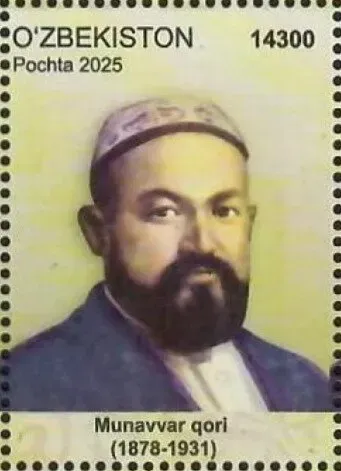
Munavvar Qori Abdurashidkhonov
Leader of the Tashkent Jadids, educator and publisher who opened the city’s first new-method school in 1901, wrote textbooks and ran newspapers; he was shot in Moscow in 1931.
- Occupation:
- Writer, Politician, Educator
- Nickname:
- Munawwar Qari
- Born:
- 1878 — May 23, 1931
- Birthplace:
- Shayxontoxur District, Tashkent
- Father:
- Abdurashidkhon
- Mother:
- Khosiyat Otin
Biography
Munavvar Qori Abdurashidkhonov was born in 1878 in Tashkent, in the Darkhon neighbourhood of the Shaykhontohur quarter. His father Abdurashidkhon, son of Sotiboldikhon, was a madrasa teacher (mudarris); his mother Khosiyat Otin, daughter of the scholar Khonkhoja Shorahimkhojayev, taught girls to read at home. Munavvar was the third son; his father died early and his mother gave him his first lessons. Under the Tashkent teacher Usmon Domla he learned the art of Qur’an recitation (tajwid), memorised the Qur’an and earned the title “qori”, reciter. He studied at the Yunuskhan and Eshonquli Dodkhoh madrasas in Tashkent and at the Mir-i Arab madrasa in Bukhara, but left without finishing and went back to Tashkent, where he served as imam of the Darkhon mosque and as a teacher.
In 1901 Munavvar Qori opened Tashkent’s first new-method (Jadid) school, where children learned to read by the phonetic method, and later more such schools in other parts of the city. He drew up their curriculum and wrote their textbooks: the primer “Adibi avval” (“The First Teacher”, 1907), which went through eight editions by 1917, the reader “Adib us-soniy” (“The Second Teacher”, 1907), the arithmetic book “Usuli hisob”, the Qur’an-reading manual “Tajvid” (1911), books on religious practice, on the history of the prophets, of Islam and of the Turkic peoples, and the geography textbook “Yer yuzi” (“The Face of the Earth”). In 1914 he published “Sabzazor”, an anthology of contemporary Uzbek poets.
From 1906 he wrote for the newspaper “Taraqqiy”, and when it was shut down he founded and edited his own paper, “Khurshid”, which the authorities banned in turn after ten issues. He later guided the newspapers “Shuhrat”, “Tujjor” and “Osiyo” from behind the scenes, was deputy managing editor of “Sadoyi Turkiston” in 1914–1915 and the unofficial editor of the journal “Al-isloh” in 1915–1917. In 1909, with Tashkent merchants, he set up the charitable society Jamiyati Imdodiya and became its deputy chairman; it paid for the schooling of poor children and sent young men to study in Ufa, the Caucasus, the Ottoman Empire and Egypt.
In 1913 Munavvar Qori and Abdulla Avloniy founded the Turon society, with a library, a reading room, a publishing house and an amateur theatre troupe. On 27 February 1914 the troupe staged Mahmudkhoja Behbudiy’s play “Padarkush” (“The Patricide”) in the Colosseum building in Tashkent, one of the first performances from which the history of the Uzbek national theatre is counted.
After the February Revolution of 1917 he became one of the leaders of Shura-i Islamiya, an organisation founded in Tashkent in March, and headed the preparations for the first congress of Turkestan’s Muslims (16–23 April), which first raised the demand for the region’s autonomy. He founded the newspaper “Najot”, edited “Kengash”, and at the end of the year supported the Turkestan Autonomy proclaimed in Kokand. In 1918 he was among the organisers of the Turkestan Muslim People’s University: with Murodkhoja Domla and Burhon Habib he drew up its programme, and he taught the native language and literature there, but the Soviet authorities closed the university that September.
In 1920–1921, at Fayzulla Khojayev’s invitation, he headed the waqf department of the education ministry of the Bukharan People’s Soviet Republic, and in September 1920 he was a delegate to the Congress of the Peoples of the East in Baku. In 1921 he spent several months under arrest. He then taught in Tashkent at the Navoi school, the Narimanov pedagogical college and the women’s teacher-training institute (1923–1925), wrote the four-part textbook “O'zbekcha til saboqligi” (“Lessons in Uzbek”, 1925–1926) with Shorasul Zunnun and Qayum Ramazon, worked as a researcher at the Samarkand museum and served as secretary of the Tashkent–Fergana branch of the committee for the protection of ancient monuments (1927–1928).
On 6 November 1929 Munavvar Qori was arrested together with dozens of Uzbek intellectuals in the case of the secret organisations Milliy Ittihod and Milliy Istiqlol, and the investigation was moved to Moscow. On 25 April 1931 the OGPU Collegium sentenced him to death, and he was shot in Moscow on 23 May; he was buried at the Vagankovo cemetery. He was rehabilitated in the last years of the Soviet Union. In independent Uzbekistan his selected works were published (2003), and in 2020 he was posthumously awarded the Order “For Outstanding Merit”.
Education
- Mir-i Arab MadrasaMadrasa · Bukhara
- Yunuskhan MadrasaMadrasa · Tashkent
- Eshonquli Dodkhoh MadrasaMadrasa · Tashkent
Career
- Turon theatre troupeCo-founder of the Turon society · Tashkent · 1913–…
- Khurshid newspaperFounder and editor · Tashkent · 1906–1906
- Jamiyati Imdodiya charitable societyDeputy chairman · Tashkent · 1909–…
- Sadoyi Turkiston newspaperDeputy managing editor · Tashkent · 1914–1915
- Shura-i IslamiyaOne of the leaders · Tashkent · 1917–1918
- Najot newspaperFounder and editor · Tashkent · 1917–1917
- Turkestan Muslim People’s UniversityCo-organiser and teacher · Tashkent · 1918–1918
- Ministry of Education of the Bukharan People’s Soviet RepublicHead of the waqf department · Bukhara · 1920–1921
Awards
 Order «For Outstanding Merit»2020, posthumously · Uzbekistan
Life path
- 1890sMadrasa studies
Studied at the Yunuskhan and Eshonquli Dodkhoh madrasas in Tashkent and the Mir-i Arab madrasa in Bukhara; memorised the Qur’an and became a “qori”.
- 1901The first new-method school
Opened Tashkent’s first Jadid school, which taught reading by the phonetic method.
- 1906“Khurshid”
Founded and edited the newspaper, which was banned after ten issues.
- 1907“Adibi avval” and “Adib us-soniy”
Published a primer and a reader for the new-method schools.
- 1909Jamiyati Imdodiya
Co-founder and deputy chairman of a charitable society that paid for poor children’s schooling and sent young men to study abroad.
- 1913–1914The Turon society and theatre
Founded the society with Abdulla Avloniy; on 27 February 1914 its troupe staged “Padarkush” in Tashkent.
- 1914–1917“Sadoyi Turkiston” and “Al-isloh”
Deputy managing editor of the newspaper and unofficial editor of the journal.
- 1917Shura-i Islamiya and autonomy
One of the organisation’s leaders and organiser of the first congress of Turkestan’s Muslims; founded the newspaper “Najot” and supported the Turkestan Autonomy.
- 1918The Muslim People’s University
Co-author of the university’s programme and teacher of the native language and literature.
- 1920–1921In Bukhara
Head of the waqf department of the Bukharan republic’s education ministry; delegate to the Congress of the Peoples of the East in Baku.
- 1923–1928Teacher and museum researcher
Taught at Tashkent colleges, co-wrote “O'zbekcha til saboqligi” and worked at the Samarkand museum and the committee for the protection of monuments.
- 1929–1931Arrest and execution
Arrested on 6 November 1929 and shot in Moscow on 23 May 1931.
Works
- “The First Teacher” (“Adibi avval”) (1907)Primer
A primer teaching reading by the phonetic method; eight editions appeared by 1917.
- “The Second Teacher” (“Adib us-soniy”) (1907)Reader
A reader to follow the primer, including the author’s poem “The Generous Pauper” (“Himmatli faqir”).
- “The Principles of Arithmetic” (“Usuli hisob”) (1911)Textbook
An arithmetic textbook for the new-method schools.
- “Tajvid” (1911)Textbook
A manual on the rules of Qur’an recitation.
- “A History of the Turkic People” (“Tarixi qavm turk”) (1911)Textbook
A school book on the history of the Turkic peoples.
- “Religious Needs” (“Havoyiji diniya”) (1912)Textbook
A three-part manual on religious practice.
- “A History of Islam” (“Tarixi islomiya”) (1912)Textbook
A school book on the history and spread of Islam.
- “The Face of the Earth” (“Yer yuzi”)Textbook
A geography textbook used in Turkestan’s schools until 1928.
- “Sabzazor” (1914)Anthology
A collection of poems by contemporary Uzbek poets.
- “Lessons in Uzbek” (“O'zbekcha til saboqligi”) (1925)Textbook
A four-part native-language textbook written with Shorasul Zunnun and Qayum Ramazon (1925–1926); the fourth part was confiscated.
Legacy
Munavvar Qori is regarded as the leader of the Tashkent Jadids: the city’s first new-method school and its textbooks, the national newspapers, the Turon society and theatre and the autonomy movement of 1917 are all tied to his name. His primer “Adibi avval” and geography textbook “Yer yuzi” served Turkestan’s schools for years. In Soviet times the study of his work was forbidden, and his life and legacy have been researched in earnest only since independence.
Era: Turkestan Jadidism, early 20th century- Opened Tashkent’s first new-method school (1901)
- The Turon troupe staged “Padarkush” in Tashkent (1914)
- Shot in Moscow (1931)
- His selected works were published (2003)
- Posthumously awarded the Order “For Outstanding Merit” (2020)