Abdulla Avloniy
Tashkent educator, poet, playwright and teacher, author of textbooks for the Jadid schools and of “A Turkic Gulistan, or Ethics”, founder of the Turon theatre troupe.
- Occupation:
- Writer, Politician, Educator, Poet, Playwright
- Born:
- July 12 1878(56 years old) ♋ — August 25, 1934
- Birthplace:
- Tashkent
- Father:
- Miravlon
- Mother:
- Fotima
- Spouse:
- Salomatxon Islomova
- Children:
- Savriniso Avlonova, Karima Avlonova, Hakima Avlonova, Asatulla Avlonov, Otaliq Avlonov, Kenja Avlonov
Biography
Abdulla Avloniy was born on 12 July 1878 in the Mergancha quarter of Tashkent. His grandfather Mirne'matboy came from Kokand; his father Miravlon was a weaver who sold coarse cotton and calico at the bazaar, and his mother was called Fotima; documents of the time record him as Mulla Abdulla Avlonov. From the age of seven he learned to read at an old-style school in the O'qchi quarter, in 1890 he entered the local madrasa, and later he studied at the Abdumalikboy madrasa in Shayxontohur. The family was poor, so he worked as a day labourer in summer and studied only in winter; in the end he gave up his studies and learned the building trades — brick-making, plastering, stove-building and carpentry. In these years he read Navoiy, Fuzuli, Sa’di and Hafiz, learned Persian and began to write poetry.
In 1900 he married Salomatxon, the daughter of a Tashkent merchant. In 1904 he opened a new-method (Jadid) school in Mirobod, and word soon spread through the city that it taught children to read and write in six months and gave lessons in geography, arithmetic and nature study. Conservative neighbours accused the teacher of unbelief and had the school closed, and Avloniy opened another in the Degrez quarter. In 1909 he and his associates founded the charitable society “Jamiyati xayriya”, which raised money to school children from poor families. For his pupils he wrote the textbooks “The First Teacher”, “The Second Teacher” (1912), “A Turkic Gulistan, or Ethics” (1913) and “The School Rose Garden” (1916), and he published the collection “Literature, or National Poems” in parts between 1909 and 1916.
Avloniy was one of the founders of the Uzbek national press. On 4 December 1907 the first issue of the newspaper “Shuhrat” came out under his editorship; it was produced in his house on Sapyornaya Street and was shut down after its tenth issue, in February 1908. He then obtained a licence in another man’s name and began to publish the newspaper “Osiyo”, which was soon banned as well. In 1914–1915 he wrote a great deal for the newspaper “Sadoyi Turkiston”, and in 1914 and 1916 he was among the founders of the publishing companies “Nashriyot” and “Maktab”.
At the end of 1913 an amateur theatre troupe led by Avloniy took shape within the Turon society founded by the Tashkent Jadids. Its first production was Mahmudkhoja Behbudiy’s drama “Padarkush” (“The Patricide”), staged on 27 February 1914 at the Kolizey (Colosseum) theatre in Tashkent. The troupe toured the towns of the Fergana Valley; Avloniy wrote plays for it — “Is It Easy to Be a Lawyer?”, “Pinak”, “We and You”, “Two Loves” — translated stage works from Tatar and Azerbaijani and acted himself. The songs he wrote in 1916 for the send-off of the men drafted for labour behind the front were later published as the book “Songs of the Labourers”.
After the February Revolution of 1917 he started the newspaper “Turon” under the slogan “Long live the people’s republic!”, but when it printed an article exposing ignorance in Bukhara, the conservative clergy declared him an apostate and he had to give up the editorship. The same year he organised a teachers’ union and was elected to the Tashkent Soviet of Workers’ and Soldiers’ Deputies. In 1918 he joined the Communist Party, chaired the executive committee of Tashkent’s Old City, founded the newspaper “Ishtirokiyun” and became its editor; he was elected to the Central Committee of the Communist Party of Turkestan and to the Turkestan Central Executive Committee.
In June 1919 Avloniy went to Afghanistan on a mission from the government of Soviet Russia, and from 28 September 1919 to 20 July 1920 he was consul general in Herat; his impressions survive in his diaries “The Afghan Journey”. Recalled because of ill health, he headed the culture department of the Turkestan Bureau and edited the magazine “Kasabachilik harakati”. From 1921 he devoted himself to education: he ran teacher-training schools in Tashkent, among them one for women, taught at a military school and, from 1925, at the Communist University of Central Asia and the Central Asian State University (now the National University of Uzbekistan), where in 1930 he became a professor and headed the department of language and literature of the faculty of education. In 1933 he compiled a literature reader for the seventh grade. He received the title of Hero of Labour in 1927 and that of Shock Worker of Public Education of Uzbekistan in 1930.
Abdulla Avloniy died in Tashkent on 25 August 1934. He was never repressed, but his works went unpublished for many years; the study of his legacy began in the 1960s, the collection “Toshkent tongi” (“Tashkent Dawn”) came out in 1979 and the Afghan diaries in 1990. In independent Uzbekistan his writings have been republished, and a street, neighbourhoods and schools in Tashkent, as well as an institute for teachers’ professional development, bear his name. In 2019 the feature film “Avloniy”, about his mission to Afghanistan, was released, and in 2020 he was posthumously awarded the Order “For Outstanding Merit”.
Education
- Abdumalikboy MadrasaMadrasa · Shayxontoxur District
Career
- Shuhrat newspaperFounder and editor · Tashkent · 1907–1908
- Osiyo newspaperPublisher · Tashkent · 1908–1908
- Turon newspaperFounder and editor · Tashkent · 1917–1917
- Executive Committee of Tashkent’s Old CityChairman · Tashkent · 1918–1918Everyone who held this post →
- Ishtirokiyun newspaperFounder and editor · Tashkent · 1918–1919
- Kasabachilik harakati magazineEditor · Tashkent · 1921–1921
- National University of UzbekistanLecturer, from 1930 professor and head of the department of language and literature (then the Central Asian State University) · Tashkent · 1925–1934
Awards
 Order «For Outstanding Merit»2020, posthumously · Uzbekistan
Life path
- 1885–1895School and madrasa
Studied at an old-style school in the O'qchi quarter, then at madrasas; poverty made him work as a labourer in summer.
- 1904A Jadid school in Mirobod
Opened a new-method school in Tashkent’s Mirobod quarter and taught there himself.
- 1907–1908“Shuhrat” and “Osiyo”
Published the newspaper “Shuhrat” from his home and, after it was closed, “Osiyo”.
- 1909“Jamiyati xayriya”
Founded a society that raised money to school children from poor families; published the first part of “Literature, or National Poems”.
- 1912–1916Textbooks
“The Second Teacher”, “A Turkic Gulistan, or Ethics” and “The School Rose Garden” came out.
- 1913–1916The Turon theatre troupe
Led the troupe; on 27 February 1914 it staged “Padarkush” in Tashkent.
- 1917“Turon” and the teachers’ union
Published a newspaper, organised a teachers’ union and was elected to the Tashkent Soviet of Workers’ and Soldiers’ Deputies.
- 1918–1919“Ishtirokiyun”
Founded and edited the newspaper; chairman of the executive committee of Tashkent’s Old City.
- 1919–1920Consul general in Herat
Served in Afghanistan for the government of Soviet Russia and kept the diaries “The Afghan Journey”.
- 1921–1929Teacher-training schools and a military school
Ran teacher-training schools in Tashkent and taught at a military school.
- 1925–1934Central Asian State University
Taught there; became a professor in 1930 and headed the department of language and literature.
- 1934Death
Died in Tashkent on 25 August.
Works
- “Literature, or National Poems” (“Adabiyot yoxud milliy she'rlar”) (1909)Poetry collection
A collection in four parts published in 1909–1916 and reprinted several times; the author counted his later books as its continuation.
- “The First Teacher” (“Birinchi muallim”)Primer
A reading primer for the first year of the new-method schools, published four times before 1917.
- “The Second Teacher” (“Ikkinchi muallim”) (1912)Reader
A reader to follow the primer: moral stories and poems, some of them free translations from Tolstoy and Krylov.
- “A Turkic Gulistan, or Ethics” (“Turkiy guliston yoxud axloq”) (1913)Ethics textbook
A book on ethics for senior pupils, modelled on Sa’di’s “Gulistan”; a second edition came out in 1917.
- “The School Rose Garden” (“Maktab gulistoni”) (1916)Reader
A collection of poems and stories for schoolchildren.
- “Is It Easy to Be a Lawyer?” (“Advokatlik osonmi?”)Play
A play about a lawyer back from his studies in Russia who tries to help his unlettered countrymen, written for the Turon troupe.
- “Pinak”Play
A satirical play about the lives of opium smokers and gamblers.
- “Songs of the Labourers” (“Mardikorlar ashulasi”) (1917)Poetry collection
Songs performed in 1916 at the send-off of men drafted for labour behind the front.
- “The Afghan Journey” (“Afg'on sayohati”)Diaries
Diaries kept in Afghanistan in 1919–1920, published in 1990 in the magazine “Sharq yulduzi”.
- “A Literature Reader” (1933)Textbook
A reader compiled for the seventh grade of Uzbek schools.
Legacy
Avloniy is regarded as one of the leaders of the Tashkent Jadids: the new-method schools and their textbooks and the beginnings of the Uzbek national press, theatre and children’s literature are tied to his name. “A Turkic Gulistan, or Ethics” is still republished and studied as a landmark of Uzbek educational thought. A street, two neighbourhoods and schools in Tashkent and an institute for teachers’ professional development bear his name, and the Writers’ Union of Uzbekistan established a children’s literature prize named after him.
Era: Turkestan Jadidism and the early Soviet years- A. Boboxonov and M. Maxsumov published a book on Avloniy’s work as an educator (1966)
- The collection of his writings “Toshkent tongi” (“Tashkent Dawn”) was published (1979)
- The diaries “The Afghan Journey” appeared in the magazine “Sharq yulduzi” (1990)
- The feature film “Avloniy” was released (2019)
- Posthumously awarded the Order “For Outstanding Merit” (2020)
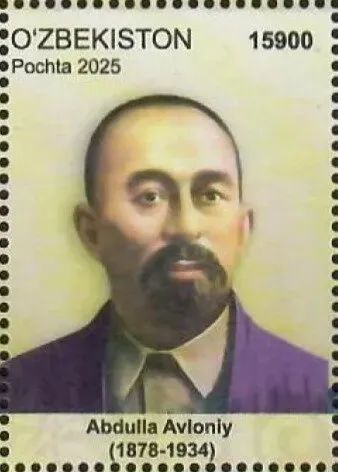
- Uzbekistan Post issued a stamp with his portrait in the series “Jadids — Heroes of the Nation” (2026)