Mukhtar Ashrafi
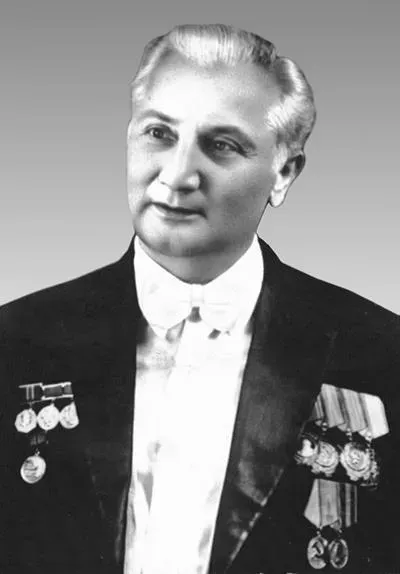
Uzbek composer and conductor, co-author of the first Uzbek opera, Buran (with Sergei Vasilenko), and author of the first Uzbek symphony; People's Artist of the USSR (1951) and twice a Stalin Prize laureate.
Biography
Mukhtar Ashrafi was born in Bukhara on 11 June 1912 (29 May Old Style) into the family of Ashrafjon, a well-known hafiz singer and dutar player who became his first teacher. From the age of seven the boy played folk instruments. In 1924 he entered the dutar class of the Bukhara School of Oriental Music, and in 1929–1931 he studied music theory with Nikolai Mironov at the Research Institute of Music and Choreography in Samarkand, and in 1929–1930 he also headed the artistic department of Samarkand radio.
From 1930 his work was bound up with the Uzbek musical theatre in Tashkent: until 1934 he ran its music department, and then became its artistic director and chief conductor. In 1934–1936 he studied composition at the Moscow Conservatory with Sergei Vasilenko and Boris Shekhter. With Vasilenko he wrote the opera “Buran” to a libretto by Komil Yashin; its staging in 1939 is regarded as the birth of Uzbek opera, and the same year the company became the Navoi Uzbek Theatre of Opera and Ballet. In 1937, as a participant in the festival of Uzbek art in Moscow, Ashrafi received the Order of the Badge of Honour and the title of Honoured Artist of the Uzbek SSR, and in 1939 he became a People's Artist of the Uzbek SSR. Their second joint opera, “The Great Canal”, was staged in 1941.
During the war the Leningrad Conservatory was evacuated to Tashkent, and in 1941–1944 Ashrafi studied composition there with Maximilian Steinberg; in 1948 he graduated from its conducting faculty as an external student. His Symphony No. 1, the “Heroic” (1942), was the first Uzbek symphony, and in 1943 it won him a Stalin Prize, second class, which he gave to the defence fund to build an air squadron and a tank column. He was director of the Navoi Theatre in 1943–1947. From 1944 he taught conducting at the Tashkent Conservatory, which he headed as director in 1947–1962 while also chairing its department of opera training. In 1940–1948 he was deputy chairman of the organising committee of the Union of Composers of Uzbekistan, and from 1948 he sat on the boards of the composers' unions of Uzbekistan and the USSR.
In 1951 Ashrafi was named a People's Artist of the USSR and received the Order of Lenin, and in 1952 he won a second Stalin Prize for the cantata “Song of Happiness” to verses by Temur Fattoh. His opera “Dilorom” was staged in 1958 and “The Poet's Heart” in 1962. Around 1960 he was accused of borrowing music and of leaving out the names of co-authors who had written much of the music in joint works; the journal “Sovetskaya Muzyka” wrote about it in 1960. Ashrafi was expelled from the Union of Composers and later readmitted.
In 1964–1966 he was director, artistic director and chief conductor of the Samarkand Theatre of Opera and Ballet, and from 1966 he again led the Navoi Theatre. These years brought his ballets “The Amulet of Love” (1969), “Timur Malik” (1970), “Steadfastness” (1971) and “Love and the Sword” (1973). He also wrote for the cinema, including the scores for “Nasreddin in Bukhara” (1943), “The Rakhmanov Sisters” (1954), “Semurg” (1972) and “Sunrise over the Ganges” (1975). In 1970 he received the Hamza State Prize of the Uzbek SSR and in 1972 a second Order of Lenin; his ballets “The Amulet of Love” and “Steadfastness” brought him the international Jawaharlal Nehru and Gamal Abdel Nasser prizes.
From 1971 Ashrafi was rector of the Tashkent Conservatory. His last major work was the oratorio “The Tale of Rustam” (1974), based on Ferdowsi's “Shahnameh”. He wrote the book “Indian Diaries” and the memoir “Music in My Life” (1975). He died in Tashkent on 15 December 1975 and was buried at the Chigatai cemetery.
In 1976 the Tashkent Conservatory was named after Mukhtar Ashrafi, and in 1982, for his 70th anniversary, a memorial museum opened in the house where he spent his last years. Streets in Tashkent and Bukhara bear his name, as does the Bukhara specialised school of arts, which grew out of a music school founded by Abdurauf Fitrat. His daughter Muqaddima Ashrafi (1936–2013) became an orientalist and his son Firuz (1937–2009) an architect.
Education
- Bukhara School of Oriental MusicSchool · Bukhara · 1924 · Dutar class
- Uzbek Institute of Music and ChoreographyOther · Samarkand · 1929–1931 · Music theory (Nikolai Mironov)
- Tchaikovsky Moscow State ConservatoryUniversity · 1934–1936 · Composition (Sergei Vasilenko, Boris Shekhter)
- Rimsky-Korsakov Leningrad ConservatoryUniversity · 1941–1948 · Composition (Maximilian Steinberg, in Tashkent, 1941–1944); conducting faculty as an external student (1948)
Career
- Union of Composers of UzbekistanDeputy chairman of the organising committee (1940–1948), board member · Tashkent · 1940–…
- Alisher Navoi State Academic Bolshoi TheatreHead of the music department, artistic director and chief conductor; director (1943–1947) · Tashkent · 1930–1971Everyone who held this post →
- State Conservatory of UzbekistanTeacher of conducting, professor; director (1947–1962), rector (1971–1975) · Tashkent · 1944–1975Everyone who held this post →
- Samarkand Theatre of Opera and BalletDirector, artistic director and chief conductor · Samarkand · 1964–1966Everyone who held this post →
- Union of Composers of the USSRBoard member · 1948–…
Awards
 People's Artist of the Uzbek SSR1939 · Uzbek SSR
 Honoured Artist of the Uzbek SSR1937 · Uzbek SSR
 Hamza State Prize of the Uzbek SSR1970 · Uzbek SSR
 People's Artist of the USSR1951 · USSR
 Order of Lenin1951 · USSR
- Order of Lenin1972 · USSR
 Order of the Red Banner of Labour1939 · USSR
- Order of the Red Banner of Labour1959 · USSR
 Order of the Badge of Honour1937 · USSR
 Stalin Prize1943 · USSR
- Stalin Prize1952 · USSR
Life path
- 1924Bukhara music school
Entered the dutar class of the Bukhara School of Oriental Music.
- 1929–1931Studies in Samarkand
Studied at the Institute of Music and Choreography while heading the artistic department of Samarkand radio.
- 1930Uzbek musical theatre
Began work in Tashkent as head of the music department, then artistic director and chief conductor.
- 1934–1936Moscow Conservatory
Studied composition with Sergei Vasilenko and Boris Shekhter.
- 1939The opera “Buran”
Premiere of the first Uzbek opera, written with Vasilenko; named People's Artist of the Uzbek SSR.
- 1942–1943The “Heroic” Symphony
The first Uzbek symphony; the Stalin Prize, second class, went to the defence fund.
- 1943–1947Director of the Navoi Theatre
Headed the Uzbek Theatre of Opera and Ballet.
- 1947–1962Director of the conservatory
Headed the Tashkent Conservatory and its department of opera training.
- 1948Conducting diploma
Graduated from the conducting faculty of the Leningrad Conservatory as an external student.
- 1951People's Artist of the USSR
Awarded the title and the Order of Lenin; a second Stalin Prize followed in 1952.
- 1964–1966Theatre in Samarkand
Director, artistic director and chief conductor of the Samarkand Theatre of Opera and Ballet.
- 1971–1975Rector of the conservatory
Led the Tashkent Conservatory until his death on 15 December 1975.
Works
- “Buran” (1939)Opera
The first Uzbek opera, written with Sergei Vasilenko to a libretto by Komil Yashin.
- “The Great Canal” (1941)Opera
A second opera with Vasilenko, to a libretto by Komil Yashin and Mamajon Rahmonov; its third version was staged in 1953.
- Symphony No. 1, “Heroic” (1942)Symphony
The first Uzbek symphony; Stalin Prize, second class (1943).
- “Nasreddin in Bukhara” (1943)Film score
A film by Yakov Protazanov; the score was written with Boris Arapov.
- Symphony No. 2, “Glory to the Victors” (1944)Symphony
The composer's second symphony.
- “Uzbekistan” (1947)Cantata
To verses by Maqsud Shaykhzoda.
- “Song of Happiness” (1951)Cantata
For voice, choir and orchestra to verses by Temur Fattoh; Stalin Prize, third class (1952).
- “Dilorom” (1958)Opera
Libretto by Komil Yashin and M. Muhamedov; it became the basis of the first Uzbek film opera.
- “The Poet's Heart” (1962)Opera
Libretto by Izzat Sulton.
- “The Amulet of Love” (1969)Ballet
Honoured with the international Jawaharlal Nehru Prize.
- “Steadfastness” (1971)Ballet
Honoured with the international Gamal Abdel Nasser Prize; staged at the Cairo Opera.
- “The Tale of Rustam” (1974)Oratorio
Based on Ferdowsi's “Shahnameh”.
Legacy
Together with Sergei Vasilenko, Ashrafi stands at the beginning of Uzbek opera, and his “Heroic” Symphony opened the history of Uzbek symphonic music. For decades he led the republic's main opera house and the Tashkent Conservatory, which was named after him in 1976. His memorial museum in Tashkent keeps his memory.
Era: The formation of the Uzbek school of composition, 1930s–1970s- Premiere of “Buran”, the first Uzbek opera (1939)
- Stalin Prize for the first Uzbek symphony (1943)
- The Tashkent Conservatory named after the composer (1976)
- The Mukhtar Ashrafi memorial museum opened in Tashkent (1982)
Filmography
| Title | Year |
|---|---|
| Nasreddin in Bukhara | 1943 |
| Sestry Rakhmanovy | 1954 |
| Rodivshiisya v grozu | 1965 |
| Born in a Thunderstorm (Natasha-khanum) | 1965 |
| Koniyut g'orining siri | 1966 |
| Simurgh | 1972 |
| Sunrise over the Ganges | 1975 |