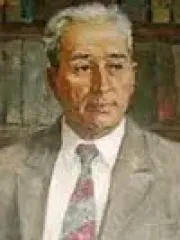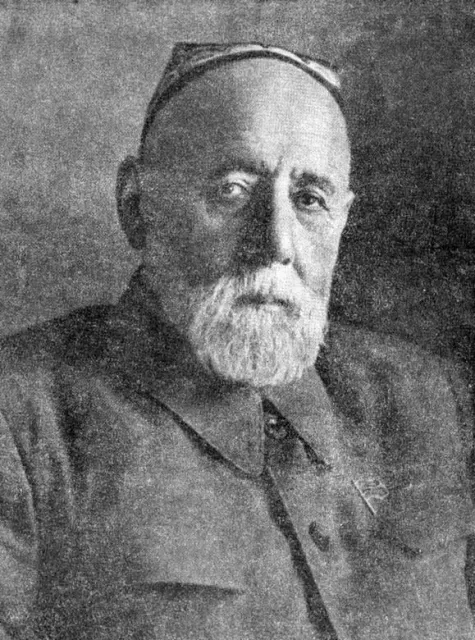
Sadriddin Ayni
Writer, poet and scholar who wrote in Tajik and Uzbek, author of the novels “Dokhunda” and “Slaves”, the novella “The Death of the Moneylender” and the memoirs “Bukhara”, and first president of the Tajik Academy of Sciences.
Biography
Sadriddin Ayni (born Sadriddin Said-Murodzoda) was born on 15 April 1878 in the village of Soktare in the Emirate of Bukhara (now in the Gijduvon district of the Bukhara region). His father, Saidmurodkhoja, a village craftsman and farmer, could read and write, loved poetry and made sure his son was taught; his mother was named Zevar. The boy went to the village school from the age of six. In 1889 a cholera epidemic took both his parents within a short time. In 1890, aged twelve, he moved to Bukhara, where Sharifjon Makhdum, a senior official of the emirate who wrote poetry as Sadri Ziyo, took him under his protection.
From 1890 to 1900 Ayni studied at the Bukhara madrasas of Mir-i Arab, Olimjon, Badalbek, Hoji Zohid and Kukeldash. Having no means, he earned his keep as a sweeper and cook at the madrasa. His real literary schooling came from the gatherings at Sharifjon Makhdum’s house, where he befriended poets such as Hayrat and read Hafez, Jami, Navoi and Bedil. He wrote his first ghazals in 1895 under the pen names Sifli, Muhtoji and Jununi, and from 1896 signed himself “Ayni”. Ahmad Donish’s “Navodir ul-vaqoe” had a strong influence on his outlook.
In the early 20th century Ayni joined the reforming Jadids. In 1907 he taught at a new-method school opened in Bukhara for Tatar children, and in 1908, with Abdulvohid Munzim, he opened a new-method school teaching in Tajik; the emir’s authorities closed it in 1909. In those years he helped found the publishing society “Shirkati Bukhoroi sharif” and the secret society “Tarbiyai atfol”. For the new schools he wrote the reader “Tahzib us-sibyon” (1909) and the handbook “Zaruriyoti diniya” (1914); he contributed to the newspaper “Bukhoroi sharif” and the journal “Oyina”, and wrote poems in both Tajik and Uzbek. From September 1915 to April 1916 he worked at a cotton-ginning plant at Kyzyltepa station, where he met the prototypes of the heroes of his later stories.
In April 1917, after the Jadids held a demonstration in support of the emir’s reform decree, arrests began in Bukhara. Ayni, who had not taken part in the march, was seized too, given 75 strokes of the rod and thrown into the Obkhona prison. The prisoners were freed by Russian soldiers who came from Kagan; Ayni spent 52 days in the Kagan hospital and then moved to Samarkand. The emir later had his younger brother Sirojiddin put to death, a loss Ayni mourned in the elegy “Marsiya” (1918). In Samarkand he opened one of the first Soviet schools and taught in it, wrote marches and songs in Tajik and Uzbek, among them “Surudi ozodi” (“Song of Freedom”, 1918), and in 1919–1921 regularly published articles and poems in the journal “Shu’lai inqilob”. In those years he married Salohat, the sister of the Samarkand Jadid Vadud Mahmud.
After the Bukharan People’s Soviet Republic was formed in 1920, Ayni worked at its consulate in Samarkand (1921–1923) and then at its trade office. At this time he turned to prose: he wrote “The Executioners of Bukhara” (1922), an indictment of the emir’s regime, and the “History of the Manghit Emirs of Bukhara” (1923), and compiled an Uzbek-language reader for girls’ schools, “The Girl, or Kholida” (1924). “Odina”, which a newspaper began to serialise in 1924, is regarded as the start of modern Tajik prose. In 1926 his anthology “Samples of Tajik Literature” came out in Moscow, bringing together a thousand years of poetry, from Rudaki to the early 20th century, with notes on more than two hundred poets. From 1926 to 1933 he was an editor and scholarly consultant at the Tajik State Publishing House, founded in Samarkand, and published satirical feuilletons in the Uzbek press.
The 1930s were his most productive years. The novel “Dokhunda” (written in 1927–1928, published in 1930), about the poor highlander Yodgor during the revolution, is regarded as the first novel in Tajik. Ayni first wrote the novel “Slaves”, which spans a century from the early 19th century to the 1930s, in Uzbek: it came out in Tashkent in 1934, and in Tajik in 1935. Then came the novellas “The Old School” (1935), “The Death of the Moneylender” (1939), with its satirical portrait of the miser Qori Ishkamba, and “The Orphan” (1940). At the First Congress of Soviet Writers in 1934 he was elected to the board of the Union of Soviet Writers.
During the Second World War Ayni turned to heroes of the past, writing historical stories about Temur Malik, who defended Khujand against the Mongols, and about Muqanna’s revolt against the Arabs (both 1944). As a scholar he wrote studies of Rudaki (1940), Ibn Sina (1939), Ferdowsi, Saadi (1942), Alisher Navoi (1948) and Bedil (1954). In 1941 he took part in the opening of Amir Timur’s tomb in Samarkand. He was named Honoured Scientist of the Tajik SSR in 1940, was elected an honorary member of the Academy of Sciences of Uzbekistan in 1943, and received a doctorate in philology. In 1949–1954 he wrote his four-part memoirs of Bukhara at the turn of the 20th century, published in Russian as “Bukhara”; the first two parts won him a Stalin Prize in 1950. From 1950 he was a deputy of the Supreme Soviet of the USSR, and from April 1951 until his death he was the first president of the Academy of Sciences of the Tajik SSR.
Sadriddin Ayni died in Stalinabad (now Dushanbe) on 15 July 1954. A mausoleum was built for him there the same year, and a park named after him was later laid out around it. In 1967 a memorial museum opened in his house in Samarkand; there are also house museums in his native village and in Dushanbe. In the 1960s his works were published in Uzbek in eight volumes, and his books have been translated into Russian, French, Polish, Czech, Urdu and other languages. He was posthumously named Hero of Tajikistan in 1998 and, in 2001, posthumously awarded Uzbekistan’s Order “Buyuk xizmatlari uchun” (“For Outstanding Merit”). Streets in Samarkand and Bukhara bear his name, and a monument to him stands in Samarkand. With his wife Salohat he raised a son, Kamol, who became an orientalist, and daughters Kholida and Lutfiya.
Education
- Mir-i Arab MadrasaMadrasa · Bukhara · 1890–1891
- Olimjon MadrasaMadrasa · Bukhara · 1892–1893
- Badalbek MadrasaMadrasa · Bukhara · 1894–1896
- Hoji Zohid MadrasaMadrasa · Bukhara · 1896–1899
- Kukeldash Madrasa (Bukhara)Madrasa · Bukhara · 1899–1900
Career
- Academy of Sciences of UzbekistanHonorary member · Tashkent · 1943–1954
- Union of Soviet WritersBoard member · 1934–1954
- Tajik State Publishing HouseEditor, scholarly and literary consultant · 1926–1933
- Academy of Sciences of TajikistanAcademician, first president · 1951–1954Everyone who held this post →
- Supreme Soviet of the USSRDeputy (3rd and 4th convocations) · 1950–1954
Awards
 Order «For Outstanding Merit»2001, posthumously · Uzbekistan
 Order of Lenin1941 · USSR
- Order of Lenin1948 · USSR
- Order of Lenin1949 · USSR
 Order of the Red Banner of Labour1953 · USSR
 Stalin Prize1950 · USSR
Life path
- 1878Birth
Born on 15 April in the village of Soktare near Gijduvon.
- 1889–1890Orphaned, to Bukhara
Lost both parents in a cholera epidemic; at twelve he came to Bukhara and lived under the protection of Sharifjon Makhdum.
- 1890–1900Madrasa years
Studied at the Mir-i Arab, Olimjon, Badalbek, Hoji Zohid and Kukeldash madrasas; from 1896 wrote poetry under the pen name “Ayni”.
- 1908–1909New-method school
Opened a new-method school teaching in Tajik with Abdulvohid Munzim and wrote the reader “Tahzib us-sibyon” for it; the school was closed in 1909.
- 1917Prison and Samarkand
Flogged with 75 strokes and imprisoned on the emir’s orders; after his release he moved to Samarkand.
- 1918–1921Poetry and journalism
Wrote marches in Tajik and Uzbek, published articles in the journal “Shu’lai inqilob” and opened a school in Samarkand.
- 1924–1926“Odina” and the anthology
Serialisation of “Odina” began; in 1926 the anthology “Samples of Tajik Literature” appeared.
- 1926–1933Tajik State Publishing House
Worked as an editor and scholarly consultant.
- 1930–1939Novels and novellas
“Dokhunda” (1930), “Slaves”, written in Uzbek (1934), and “The Death of the Moneylender” (1939) were published.
- 1943Academy of Sciences of Uzbekistan
Elected an honorary member of the academy.
- 1949–1954The memoirs
Wrote his four-part memoirs; the first parts won him a Stalin Prize in 1950.
- 1951–1954Tajik Academy of Sciences
First president of the academy; died in Stalinabad on 15 July 1954.
Works
- “Tahzib us-sibyon” (“The Education of Children”) (1909)Textbook
A reader for the new-method schools.
- “The Executioners of Bukhara” (1922)Story
His first prose work, exposing the emir’s regime through the talk of prison guards.
- “History of the Manghit Emirs of Bukhara” (1923)History
On the Manghit dynasty, which ruled Bukhara from the mid-18th century to 1920.
- “Odina” (1924)Novella
About the mountain peasants of eastern Bukhara; regarded as the start of modern Tajik prose.
- “Samples of Tajik Literature” (1926)Anthology
Poetry from Rudaki to the early 20th century, with notes on the poets.
- “Dokhunda” (1930)Novel
The highlander Yodgor during the revolution; the first novel in Tajik.
- “Slaves” (1934)Novel
A century of peasant life, written first in Uzbek; the Tajik version came out in 1935.
- “The Old School” (1935)Novella
About schooling in the traditional maktab.
- “The Death of the Moneylender” (1939)Novella
A satire on the Bukharan miser and moneylender Qori Ishkamba on the eve of the revolution.
- “Master Rudaki” (1940)Study
On Rudaki, the founder of Persian-Tajik poetry.
- “Alisher Navoi” (1948)Monograph
Navoi’s life and work and his place in Tajik and Uzbek literature.
- “Memoirs” (“Bukhara”) (1949)Memoirs
Four parts on life in Bukhara at the turn of the 20th century (1949–1954); awarded a Stalin Prize in 1950.
Legacy
Ayni belongs equally to Tajik and Uzbek literature. The Soviet encyclopedia calls him the founder of Tajik Soviet literature and one of the pioneers of Uzbek Soviet literature, while the Encyclopaedia Iranica credits him, more than anyone else, with establishing the norms of the modern Tajik literary language. His novel “Slaves” was first written in Uzbek, and in the 1960s his works were published in Uzbek in eight volumes. His memoirs are read as an important source on life in late 19th-century Bukhara and have also been translated into English. Museums, streets and institutions in Samarkand, Bukhara and Dushanbe bear his name.
Era: The Jadid era and Tajik and Uzbek literature of the first half of the 20th century- The anthology “Samples of Tajik Literature” was published (1926)
- Stalin Prize for the memoirs (1950)
- A film was made from the novel “Dokhunda” (1956)
- The Ayni memorial house museum opened in Samarkand (1967)
- Posthumously named Hero of Tajikistan (1998)
- Posthumously awarded the Order “Buyuk xizmatlari uchun” (2001)