Ali Qushji
Timurid astronomer and mathematician, a pupil of Ulugh Beg who directed the observations at the Samarkand observatory and in his last years taught at the Hagia Sophia madrasa in Istanbul.
- Occupation:
- Scientist, Mathematician, Astronomer
- Real name:
- Ala al-Din Ali ibn Muhammad al-Qushji
- Born:
- c. 1403 — 1474
- Birthplace:
- Samarkand
- Father:
- Muhammad
Biography
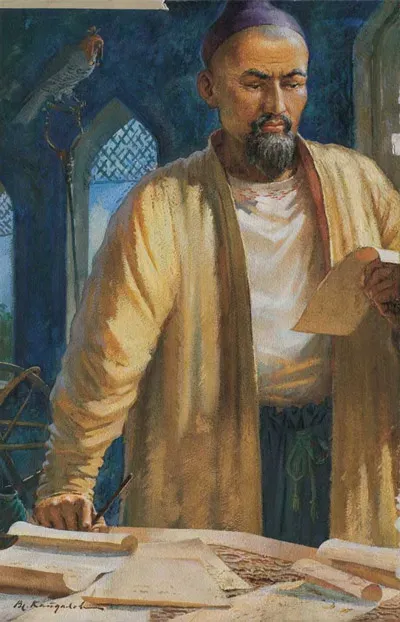
Ala al-Din Ali ibn Muhammad Qushji was born around 1403, probably in Samarkand; some sources give his kunya as Abu’l-Qasim. His father, Muhammad, was Ulugh Beg’s falconer, in charge of the court’s hunting birds, which is how the family came by the name Qushji (“falconer”). Ali learned the foundations of mathematics and astronomy in Samarkand from Ulugh Beg himself and from Qadizada al-Rumi and Ghiyath al-Din Jamshid al-Kashi.
According to tradition, eager to learn more, he left for Kerman in Iran without telling his teachers; there he studied astronomy and other sciences and came to know Nasir al-Din al-Tusi’s “Tajrid”. Returning to Samarkand in the late 1420s, he presented Ulugh Beg with a treatise he had written in Kerman and won his praise. He then worked at Ulugh Beg’s observatory, and after the death of Qadizada al-Rumi Ulugh Beg put him in charge of the observations there. Qushji took part in compiling and correcting Ulugh Beg’s “Zij-i Sultani”. The sources also say that Ulugh Beg sent him to China.
After Ulugh Beg was murdered in 1449, Qushji left Samarkand with his family and students and spent a long time in Herat. In these years he presented his great commentary on al-Tusi’s “Tajrid” to the Timurid sultan Abu Sa’id. When Abu Sa’id was defeated by the Aq Qoyunlu ruler Uzun Hasan in 1469, the scholar moved to Tabriz. Uzun Hasan received him with honour and sent him as his envoy to the Ottoman sultan Mehmed II the Conqueror.
Around 1472 Qushji settled in Istanbul for good, with his family and students; the sultan had him welcomed with ceremony. He dedicated to Mehmed II his treatise on arithmetic, “Al-Risala al-Muhammadiyya”. In 1473 he accompanied the sultan on his campaign against Uzun Hasan and marked the victory with a treatise on astronomy, “Al-Risala al-Fathiyya”. In Istanbul he taught first at the Sahn-ı Seman madrasas built by Mehmed II and was then appointed head teacher (mudarris) of the Hagia Sophia madrasa. He determined the latitude of Istanbul as 41°14′ and corrected its longitude.
Qushji left dozens of works on mathematics, astronomy, theology, the principles of law and linguistics. His Persian “Risala dar ilm al-hay'a” and “Risala dar ilm al-hisab”, together with their enlarged Arabic versions, “Al-Fathiyya” and “Al-Muhammadiyya”, served as textbooks in Ottoman madrasas. In his commentary on the “Tajrid” he argued that astronomy should not rest on Aristotle’s natural philosophy and that observation cannot rule out the Earth’s daily rotation about its axis. He proposed a model for the motion of Mercury that differs from Ptolemy’s, and in his “Commentary on Ulugh Beg’s Zij” he explained how the tables were built and pointed out some of their errors.
Ali Qushji died in Istanbul on 5 Sha’ban 879 AH, in mid-December 1474, and was buried in the cemetery around the tomb of Eyüp Sultan. Of the students he trained in Istanbul, Molla Lutfi became well known; commentaries on “Al-Fathiyya” were written by his descendant, the mathematician Mirim Chelebi, and by his student Sinan Pasha. Manuscripts of his works are kept in libraries in Tashkent, St Petersburg, Istanbul, Oxford and elsewhere. In 2020 a mosque opened near Istanbul Airport was named after him.
Career
- Ulugh Beg Observatory in SamarkandAstronomer, later head of observations · …–1449Everyone who held this post →
- Aq Qoyunlu stateUzun Hasan’s envoy to the Ottoman sultan · 1469–1472
- Ottoman court in IstanbulScholar at the court of Sultan Mehmed II, head teacher of the Hagia Sophia madrasa · 1472–1474
Life path
- 1403Birth
Born around this year, probably in Samarkand, to Muhammad, Ulugh Beg’s falconer.
- 1420sStudies in Kerman
Left for Kerman without telling his teachers and studied astronomy and other sciences there.
- late 1420sReturn to Samarkand
Presented Ulugh Beg with a treatise written in Kerman and won his praise.
- until 1449Ulugh Beg’s observatory
Worked at the observatory, directed its observations after the death of Qadizada al-Rumi and took part in compiling the “Zij-i Sultani”.
- 1449Leaving Samarkand
After Ulugh Beg’s murder moved to Herat with his family and students.
- 1450s–1460sUnder Abu Sa’id
Presented his commentary on al-Tusi’s “Tajrid” to the Timurid sultan Abu Sa’id.
- 1469In Tabriz
Went to the court of Uzun Hasan, who sent the scholar as his envoy to the Ottoman sultan.
- 1472Move to Istanbul
Settled in Istanbul around this year and dedicated “Al-Muhammadiyya” to Mehmed II.
- 1473“Al-Fathiyya” and Hagia Sophia
Accompanied the sultan on his campaign against Uzun Hasan, wrote “Al-Fathiyya” and became head teacher of the Hagia Sophia madrasa.
- 1474Death
Died in Istanbul in mid-December and was buried in the Eyüp Sultan cemetery.
Works
- “Treatise on Astronomy” (Risala dar ilm al-hay'a)Treatise on astronomy
A Persian textbook; more than eighty manuscripts are known, it was translated into Turkish and Sanskrit, and Muslih al-Din al-Lari wrote a commentary on it.
- “Treatise on Arithmetic” (Risala dar ilm al-hisab)Treatise on mathematics
A Persian work in three parts written in Transoxiana; the author’s own copy is kept in Istanbul.
- “Commentary on Ulugh Beg’s Zij” (Sharh-i Zij-i Ulugh Beg)Astronomical commentary
A Persian commentary explaining how the tables were built and pointing out some of their errors.
- “The New Commentary on the Tajrid” (Al-Sharh al-jadid ala al-Tajrid)Theological commentary
A commentary on Nasir al-Din al-Tusi’s “Tajrid al-i'tiqad”, presented to Abu Sa’id; it sets out his case for freeing astronomy from Aristotelian philosophy.
- “Al-Risala al-Muhammadiyya fi al-hisab”Treatise on mathematics
An Arabic work in an introduction and five parts, dedicated to Mehmed II.
- “Al-Risala al-Fathiyya fi ilm al-hay'a” (1473)Treatise on astronomy
An Arabic work dedicated to Mehmed II to mark his victory over Uzun Hasan; a textbook of the Ottoman madrasas, translated into Turkish in 1548 and 1824.
- “Sharh al-Risala al-wad'iyya”Linguistic commentary
A commentary on Adud al-Din al-Iji’s treatise on the relation between words and meanings; printed several times in Istanbul in the 19th century.
- “Unqud al-zawahir”Linguistic work
On Arabic vocabulary, morphology and word formation; printed in Cairo and Istanbul.
Legacy
Ali Qushji carried the achievements of the Samarkand school of astronomy into the Ottoman world: his textbooks were studied in Ottoman madrasas for centuries, and his commentaries became more popular than the texts they explained and gathered commentaries of their own. His Persian treatise on astronomy was translated into Turkish and Sanskrit. Historians of science compare his case for separating astronomy from Aristotle’s natural philosophy, and his remarks on a possibly moving Earth, with the later views of Copernicus.
Era: The Timurid and Ottoman worlds, 15th century- After Ulugh Beg’s murder Qushji left Samarkand (1449)
- “Al-Fathiyya” was presented to Mehmed II (1473)
- On the orders of Suleiman the Magnificent “Al-Fathiyya” was translated into Turkish in Aleppo (1548)
- Seyyid Ali Pasha made a new Turkish translation of “Al-Fathiyya”, “Mir'at al-alam” (1824)
- A new mosque near Istanbul Airport was named after Ali Qushji (2020)