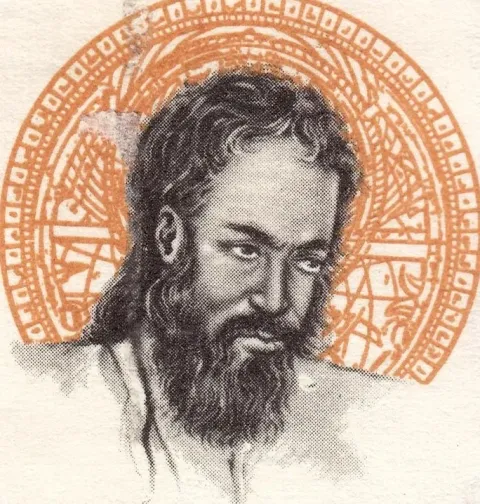
Jamshid al-Kashi
Mathematician and astronomer born in Kashan who worked in Ulugh Beg’s circle in Samarkand; used decimal fractions widely, computed 2π to 16 places and wrote “The Key to Arithmetic”.
- Occupation:
- Scientist, Mathematician, Astronomer
- Real name:
- Ghiyath al-Din Jamshid ibn Masʿud ibn Mahmud al-Kashi
- Born:
- c. 1380 — 1429
- Father:
- Masʿud
Biography
Ghiyath al-Din Jamshid ibn Masʿud ibn Mahmud al-Kashi was born around 1380 in Kashan, in central Iran, then part of Timur’s realm. In his youth he made a living as a physician and lived modestly, studying mathematics and astronomy alongside. The first event of his life that can be dated precisely is his observation of a lunar eclipse at Kashan on 2 June 1406.
On 1 March 1407 he finished the treatise “The Stairway to Heaven” (Sullam al-sama’) at Kashan, which discusses the difficulties earlier astronomers had met in fixing the sizes of the heavenly bodies and their distances. In 1410–11 he wrote a short manual of astronomy dedicated to a member of the Timurid house. Around 1413–14, building on Nasir al-Din al-Tusi’s Ilkhanic Tables, he compiled his own tables, the Khaqani Zij; in its introduction he thanks Ulugh Beg for his support, though sources differ on whether the work was dedicated to Ulugh Beg or to his father Shah Rukh.
Ulugh Beg, who ruled Samarkand, founded a madrasa there and gathered scholars, and al-Kashi was invited among them. Sources date his arrival to various years between 1416 and 1420; he is known to have stayed in the city for the rest of his life. In Samarkand, together with Qadi Zada al-Rumi, he became one of Ulugh Beg’s closest collaborators, and a fifteenth-century historian called him the “second Ptolemy”. Work on the observatory attached to the madrasa began in 1424, and al-Kashi took an active part in planning and building it. It is quite likely that Ulugh Beg’s own tables were prepared with his help and drew on his zij.
The Samarkand years produced his most important works. In July 1424 he wrote the “Treatise on the Circumference” (al-Risala al-muhitiyya), which computes 2π first to nine sexagesimal places and then to sixteen decimal places. On 2 March 1427 he completed “The Key to Arithmetic” (Miftah al-hisab), a textbook for the students of the Samarkand madrasa covering the mathematics needed in astronomy, surveying, architecture, accounting and trade; it also sets out decimal fractions and the operations on them.
Letters that al-Kashi wrote in Persian to his father in Kashan have survived and are among the best sources on scientific life in Samarkand. In them he praises Ulugh Beg’s mathematical gifts and says that of the other scholars he respects only Qadi Zada; the hard problems raised at the learned gatherings, he writes, could often be solved only by himself and Qadi Zada.
His last work was the “Treatise on the Chord and Sine” (al-Risala al-watar wa-l-jayb), in which he computed sin 1° as precisely as he had computed π and solved the cubic equation arising from the trisection of an angle by iteration. The treatise was probably left unfinished and completed by Qadi Zada. Al-Kashi died in Samarkand in 1429 (most sources give 22 June). Ulugh Beg later described him as a scholar of world renown, who had mastered the science of the ancients and could solve the hardest problems. Regular observations at the observatory had only just begun at the time of his death; they were led by Qadi Zada.
Al-Kashi was one of the mathematicians who used decimal fractions freely and consistently in practice; in Europe they were published by Simon Stevin in 1585. After Paul Luckey showed in 1948 that al-Kashi’s account matches Stevin’s, he was often called the inventor of decimal fractions; later scholars such as Roshdi Rashed point out that the idea was already present in the al-Karaji school, for example in al-Samawʾal, while still valuing al-Kashi’s own contribution highly. His value of the circumference of a circle remained a record until 1596, when Ludolph van Ceulen found a more accurate one. In France the law of cosines is sometimes called “al-Kashi’s theorem”.
Career
- Ulugh Beg Observatory in SamarkandScholar, took part in planning and building the observatory · 1424–1429
Life path
- c. 1380Birth
Born in Kashan, then part of Timur’s realm.
- 1406First dated observation
Observed a lunar eclipse at Kashan on 2 June.
- 1407“The Stairway to Heaven”
Finished at Kashan on 1 March a treatise on the sizes of the heavenly bodies and their distances.
- 1410–1411Manual of astronomy
Wrote a short work dedicated to a member of the Timurid house.
- 1413–1414Khaqani Zij
Compiled astronomical tables based on al-Tusi’s Ilkhanic Tables.
- 1416Treatise on observational instruments
Wrote a work describing instruments used for observation.
- 1416–1420Arrival in Samarkand
Came at Ulugh Beg’s invitation and joined the scholars of the madrasa.
- 1424Observatory begun; Treatise on the Circumference
In the year construction of Ulugh Beg’s observatory started, finished in July the treatise on the circumference.
- 1427“The Key to Arithmetic”
Completed the textbook Miftah al-hisab on 2 March.
- 1429Death
Died in Samarkand; most sources give 22 June.
Works
- “The Stairway to Heaven” (Sullam al-sama’) (1407)Astronomical treatise
On the difficulties of determining the sizes of the Earth, Moon, Sun and stars and their distances.
- “Khaqani Zij” (Zij-i Khaqani dar takmil-i Zij-i Ilkhani) (1413)Astronomical tables
A zij based on al-Tusi’s tables: sine values for every degree, transformations between coordinate systems and tables of planetary motion.
- Treatise on Astronomical Observational Instruments (1416)Astronomical treatise
Describes instruments used in observation, including some of the author’s own invention.
- “Nuzhat al-hada’iq” (The Delight of the Gardens)Astronomical treatise
Describes a device he built for determining the coordinates of celestial bodies and their distances.
- “Treatise on the Circumference” (al-Risala al-muhitiyya) (1424)Mathematical treatise
Computed 2π to nine sexagesimal and sixteen decimal places.
- “The Key to Arithmetic” (Miftah al-hisab) (1427)Mathematics textbook
Arithmetic, algebra, geometry and practical calculation, with an account of decimal fractions; his main work.
- “Treatise on the Chord and Sine” (al-Risala al-watar wa-l-jayb)Mathematical treatise
The precise value of sin 1° and an iterative solution of the cubic for angle trisection; left unfinished, possibly completed by Qadi Zada.
- Letters to his fatherLetters
Persian letters describing scientific life in Samarkand under Ulugh Beg.
Legacy
Al-Kashi is recognised as a scholar who raised the practice of computation to a new level: in “The Key to Arithmetic” he drew the analogy between decimal and sexagesimal fractions and applied decimals to numbers such as π, and his value of the circumference stayed the most accurate for several centuries. His iterative methods suit the numerical solution of cubic equations. His name is linked with the building of the Samarkand observatory and with Ulugh Beg’s circle of scholars. In France the law of cosines is named after him.
Era: Timurid era, early 15th century- The Treatise on the Circumference gives 2π to sixteen decimal places (1424)
- “The Key to Arithmetic” is completed (1427)
- Simon Stevin publishes decimal fractions in Europe (1585)
- Ludolph van Ceulen computes the circumference more precisely than al-Kashi (1596)
- Paul Luckey shows that al-Kashi’s account of decimal fractions matches Stevin’s (1948)
- Iranian television broadcasts the 15-part series about his life, “The Ladder of the Sky” (2009)