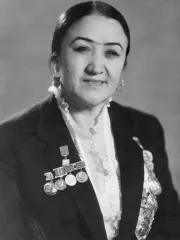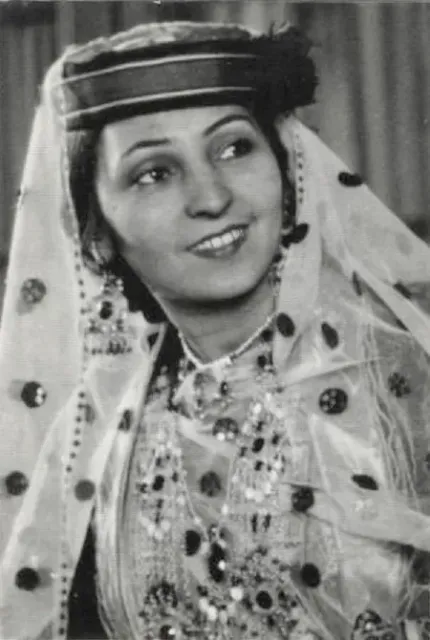
Tamara Khanum
Dancer, singer and choreographer, one of the founders of professional Uzbek dance, who performed songs and dances in 86 languages; People’s Artist of the USSR (1956) and Stalin Prize winner (1941).
Biography
Tamara Khanum (born Tamara Artyomovna Petrosyan) was born on 29 March 1906 into an Armenian family living by the Gorchakovo railway station near Margilan (today the settlement of Yangi Margilan, administered by Margilan; some reference works give her birthplace as New Margelan, now Fergana). She grew up in an Uzbek mahalla, spoke Uzbek from childhood and as a small girl already sang and danced at local festivities.
In 1919 she first appeared on stage with the agitprop troupe of Hamza Hakimzade Niyazi. A woman dancing in public with her face uncovered defied custom at the time, and the young dancer was threatened more than once. In 1921–1922 she trained in Tashkent at the Russian opera and ballet theatre and danced in concert groups led by Abror Hidoyatov, Yatim Bobojonov and Ali Ibrohimov, and in 1923–1924 she studied in Moscow at the Central Theatre School (now GITIS). It was in Moscow that she was first called the “swallow of the East”.
From 1924 she was the soloist of the concert troupe led by the singer Muhitdin Qori-Yoqubov, her first husband, which in 1926 became the Uzbek State Concert and Ethnographic Ensemble. In 1925 she performed with him in Paris at the International Exhibition of Decorative Arts, one of the first presentations of Uzbek art in Europe. In the later 1920s she also acted in musical dramas in Samarkand, Kokand and Andijan, playing Shirin in Khurshid’s “Farhad and Shirin”, Gulchehra in Uzeyir Hajibeyov’s “Arshin Mal Alan” and the title role in Ghulom Zafari’s “Halima”.
When the ensemble grew into the Uzbek State Musical Theatre in 1929 (in Tashkent from 1931, an opera and ballet theatre from 1939, today the Alisher Navoi Bolshoi Theatre), Tamara Khanum became head of its dance company. In 1932 she was named People’s Artist of the Uzbek SSR, and in 1933 she helped open the theatre’s ballet studio, which later became the Uzbek Choreographic School. In 1934–1935 she worked in Urgench as one of the founders of the Khorezm Regional Musical Drama Theatre (now named after Ogahiy), serving as its ballet master, dancer and teacher. In July 1935, with the doira player Usta Olim Komilov and the musicians Tokhtasin Jalilov and Abdukodir Ismoilov, she performed as part of the Soviet delegation at the International Folk Dance Festival in London’s Royal Albert Hall.
From 1936 Tamara Khanum was a soloist of the Uzbek State Philharmonic; until 1941 she was also a dancer and ballet master at the opera theatre, and she took part in writing the libretto of the first Uzbek ballet, Yevgeny Brusilovsky’s “Gulandom”. In 1937 she performed at the Festival of Uzbek Art in Moscow and received the first of her five Orders of the Red Banner of Labour. She joined dance to song and created the genre of the song-and-dance miniature, studying for each number the songs, dress, customs and movement of the people she portrayed. Her programmes “Songs and Dances of the Peoples of the USSR” and “Songs and Dances of the Peoples of the World” came to include more than 500 songs in 86 languages. In 1941 she received a Stalin Prize, second class, for her performance of Uzbek dances.
During the war Tamara Khanum toured with front-line concert brigades, and in 1944 she performed for Central Asian workers mobilised to factories in the Urals. From 1941 to 1969 she led the music ensemble she had founded at the Uzbek Philharmonic as its ballet master and soloist. She toured France, Britain, Poland, China, Norway, Indonesia, Czechoslovakia, India, Iran, Turkey, Mongolia and other countries. She was named People’s Artist of the USSR in 1956 and received the Order of Lenin in 1976, on her seventieth birthday. A party member from 1941, she was elected a deputy of the Supreme Soviet of the Uzbek SSR.
Tamara Khanum died in Tashkent on 30 June 1991 and was buried in the Chigatay Cemetery. Her marriage to Muhitdin Qori-Yoqubov produced a daughter, Vansetta, who became an artist and married the painter Tahir Salakhov; her second marriage, to the composer Po’lat Rahimov, produced a daughter, Lola. An exhibition of her stage costumes opened in her Tashkent house during her lifetime, in 1986, and in 1994 the house became the Tamara Khanum Memorial Museum. In 2001 she was posthumously awarded Uzbekistan’s Order “For Outstanding Merit” (Buyuk xizmatlari uchun).
Education
- Russian Institute of Theatre Arts (GITIS)University · 1923–1924 · Then the Central Theatre School
Career
- Uzbek State PhilharmonicSoloist; founder, artistic director and ballet master of its music ensemble in 1941–1969 · Tashkent · 1936–1969
- Alisher Navoi State Academic Bolshoi TheatreHead of the dance company of the Uzbek State Musical Theatre (1929–1934), dancer and ballet master (1936–1941) · Tashkent · 1929–1941
- Ogahiy Khorezm Regional Musical Drama TheatreCo-founder, ballet master, dancer and teacher · Urgench · 1934–1935
Awards
 Order «For Outstanding Merit»2001, posthumously · Uzbekistan
 People's Artist of the Uzbek SSR1932 · Uzbek SSR
 People's Artist of the USSR1956 · USSR
 Order of Lenin1976 · USSR
 Order of the Patriotic War, 2nd class1985 · USSR
 Order of the Red Banner of Labour1937 · USSR
- Order of the Red Banner of Labour1950 · USSR
- Order of the Red Banner of Labour1951 · USSR
- Order of the Red Banner of Labour1959 · USSR
- Order of the Red Banner of Labour1967 · USSR
 Order of the Badge of Honour1939 · USSR

 Medal «For the Victory over Germany»1945 · USSR

 Stalin Prize1941 · USSR
Life path
- 1919Stage debut
Danced with the agitprop troupe of Hamza Hakimzade Niyazi.
- 1923–1924Studies in Moscow
Central Theatre School (now GITIS).
- 1924–1928Qori-Yoqubov’s troupe
Soloist of the concert troupe, from 1926 the Uzbek State Concert and Ethnographic Ensemble.
- 1925Paris
Presented Uzbek dances at the International Exhibition of Decorative Arts.
- 1929–1934Uzbek State Musical Theatre
Head of the theatre’s dance company (Samarkand, in Tashkent from 1931).
- 1932People’s Artist of the Uzbek SSR
Awarded the honorary title.
- 1934–1935Khorezm theatre
One of the founders of the regional musical drama theatre in Urgench, its ballet master and teacher.
- 1935London
Performed at the International Folk Dance Festival in the Royal Albert Hall.
- 1936–1969Uzbek State Philharmonic
Soloist; from 1941 artistic director of the Philharmonic’s music ensemble.
- 1941Stalin Prize
Second class, for her performance of Uzbek dances.
- 1956People’s Artist of the USSR
Awarded the honorary title.
- 1991Death
Died in Tashkent on 30 June; her house became a memorial museum in 1994.
Works
- “Katta uyin”Dance
Uzbek folk dance; part of her programme at the London festival in 1935.
- “Qari navo”Dance
Uzbek dance, also performed at the London festival.
- “Gul uyin”Dance
Her own choreographic composition, part of her London festival programme.
- “Pilla”Dance
Her own choreographic composition, part of her London festival programme.
- Khorezm suiteDance cycle
“Dilkhiroj”, “Sadr” and other Khorezm dances.
- “Gulandom”Ballet
The first Uzbek ballet, with music by Yevgeny Brusilovsky; she took part in writing its libretto.
- “Songs and Dances of the Peoples of the USSR”Concert programme
A programme of songs and dances of the Soviet peoples.
- “Songs and Dances of the Peoples of the World”Concert programme
The two programmes held more than 500 songs in 86 languages.
Filmography
| Title | Year |
|---|---|
| Tamara Khanum | 1957 |
| Tamara’s Songs | 1962 |
| Tamara Khanum Sings | 1964 |