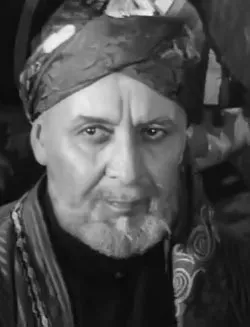
Razzoq Hamroyev
Uzbek stage and film actor, theatre director and teacher, People's Artist of the USSR (1969), who won a Stalin Prize for playing Navoi in “Alisher Navoi” and was chief director of the Muqimiy Theatre (1959–1976).
- Occupation:
- Actor, Director, Film actor, Stage actor
- Born:
- November 30 1910(70 years old) ♐ — May 5, 1981
- Birthplace:
- Shofirkon District, Bukhara
- Children:
- Guli Hamroyeva
Biography
Razzoq Hamroboyevich Hamroyev was born on 30 November 1910 in the village of Tezguzar near Bukhara, in what is now the Shofirkon District of the Bukhara Region; some Soviet reference works, the Great Soviet Encyclopedia among them, give 15 May 1910 and the town of Perovsk instead. After school in Tezguzar he studied at the Men's Institute of Education in Tashkent, acting in amateur productions while still a student. On graduating in 1930 he was assigned to Namangan to teach Uzbek language and literature.
At his Namangan school Hamroyev started a drama club, directing its productions and acting in them himself. The club grew into a city theatre: in 1931 he was among the founders of the Namangan Musical Drama and Comedy Theatre, where he worked until 1945 as an actor and director, becoming chief director and artistic director in 1934. He learned directing from Mannon Uyghur in Tashkent and in 1940 attended directing courses at the Moscow Art Theatre. His Namangan productions included Komil Yashin's “Two Communists” (1932) and Schiller's “Intrigue and Love” (1939).
His film career began with Nabi Ganiyev, who cast him as the chronicler Nazim in “Tahir and Zuhra” (1945) and then in the title role of “The Adventures of Nasreddin” (1946). Playing the poet in Kamil Yarmatov's “Alisher Navoi” (1947) earned him a Stalin Prize, second class, in 1948. He returned to Navoi on stage: for the poet's 525th anniversary in 1968 he staged the musical drama “Navoi in Astrabad” at the Muqimiy Theatre and played the lead himself.
Hamroyev moved to Tashkent in 1945, and from 1946 until his death he worked at the Muqimiy Uzbek Theatre of Musical Drama and Comedy as an actor and director, serving as its chief director from 1959 to 1976. His roles there included Muqimi in Sobir Abdulla's play of that name (1954), Melivoy in Hamid Ghulam's comedy “Toshbolta in Love” (1961), Ferdinand, Malvolio, Truffaldino, Pantalone and Hamza. As a director he staged “Farhod and Shirin”, “Layli and Majnun”, “Golden Lake”, “Nurkhon”, “Guli Siyoh”, “Fergana Before Dawn”, “Toshbolta in Love” and “Secrets of the Paranja”. His work did much to shape Uzbek musical drama, and he also directed for regional theatres, including the one in Osh.
In 1954 he graduated from the directing faculty of the Ostrovsky Tashkent Theatre and Art Institute and began teaching directing there the same year, becoming a professor in 1978. He went on acting in films: al-Biruni in “Avicenna” (1956), Muqimi in “Furqat” (1959), Usto Sharif in the comedy “The Whole Mahalla Is Talking About It” (1960), Farman Shah in “The Star of Ulugh Beg” and the rope-walker Toshtemir in “The Tightrope Walkers” (both 1964). His Mirza Karim Qutidor in Yuldash Agzamov's “Days Gone By” (1969) won him the Hamza State Prize of the Uzbek SSR in 1970, a prize he had also received in 1964. Among his later roles were Ibn Iraq in “Abu Rayhan Biruni” (1974) and Sheikh Hazrat in the serial “Fiery Roads”.
He was named People's Artist of the Uzbek SSR in 1950 and People's Artist of the USSR in 1969. He received two Orders of the Red Banner of Labour, two Orders of the Badge of Honour and the Order of Friendship of Peoples (1980), and sat as a deputy in the seventh convocation of the Supreme Soviet of the Uzbek SSR.
Razzoq Hamroyev died in Tashkent on 5 May 1981 and was buried in the Chigatay cemetery. His son Javlon Hamroyev became an actor and his daughter Guli Hamroyeva a ballerina; both were named People's Artists of the Uzbek SSR. In 2003 he was posthumously awarded Uzbekistan's Order “For Outstanding Merit” (Buyuk xizmatlari uchun).
Education
- Tashkent Men's Institute of EducationCollege · Tashkent · 1930
- State Institute of Arts and Culture of UzbekistanUniversity · Tashkent · 1954 · Directing faculty (then the Ostrovsky Tashkent Theatre and Art Institute)
Career
- Supreme Soviet of the Uzbek SSRDeputy (7th convocation) · Tashkent · 1967–1971
- Muqimiy Uzbek State Musical TheatreActor and director; chief director from 1959 to 1976 · Tashkent · 1946–1981
- Namangan Musical Drama and Comedy TheatreCo-founder, actor and director; chief director and artistic director from 1934 · Namangan · 1931–1945Everyone who held this post →
Awards
 Order «For Outstanding Merit»2003, posthumously · Uzbekistan
 People's Artist of the Uzbek SSR1950 · Uzbek SSR
 Hamza State Prize of the Uzbek SSR1964 · Uzbek SSR
- Hamza State Prize of the Uzbek SSR1970 · Uzbek SSR
 People's Artist of the USSR1969 · USSR
 Order of the Red Banner of Labour1959 · USSR
 Order of Friendship of Peoples1980 · USSR
 Order of the Badge of Honour1950 · USSR
 Stalin Prize1948 · USSR
Life path
- 1930Teacher in Namangan
After the Men's Institute of Education in Tashkent he taught Uzbek language and literature in Namangan and set up a school drama club.
- 1931–1945Namangan theatre
Co-founder of the Namangan Musical Drama and Comedy Theatre; actor and director, chief director and artistic director from 1934.
- 1940Courses in Moscow
Attended directing courses at the Moscow Art Theatre.
- 1945–1947First film roles
Nazim in “Tahir and Zuhra”, Khoja Nasreddin in “The Adventures of Nasreddin” and Navoi in “Alisher Navoi”.
- 1948Stalin Prize
Second-class prize for the title role in “Alisher Navoi”.
- 1946–1981Muqimiy Theatre
Actor and director of the Muqimiy Uzbek Theatre of Musical Drama and Comedy, chief director from 1959 to 1976.
- 1950People's Artist of the Uzbek SSR
Title awarded for his work on stage and screen.
- 1954Institute diploma
Graduated from the directing faculty of the Tashkent Theatre and Art Institute and began teaching there; professor from 1978.
- 1969People's Artist of the USSR
The same year he played Mirza Karim Qutidor in “Days Gone By”.
- 1970Hamza Prize
Hamza State Prize of the Uzbek SSR for the role of Qutidor.
- 1981Death
Died in Tashkent on 5 May and was buried in the Chigatay cemetery.
- 2003Order «Buyuk xizmatlari uchun»
Awarded posthumously.